For deliveries that are expected to occur periodically, requesters can submit recurring requests. Recurring requests are requests that occur periodically.
An overview
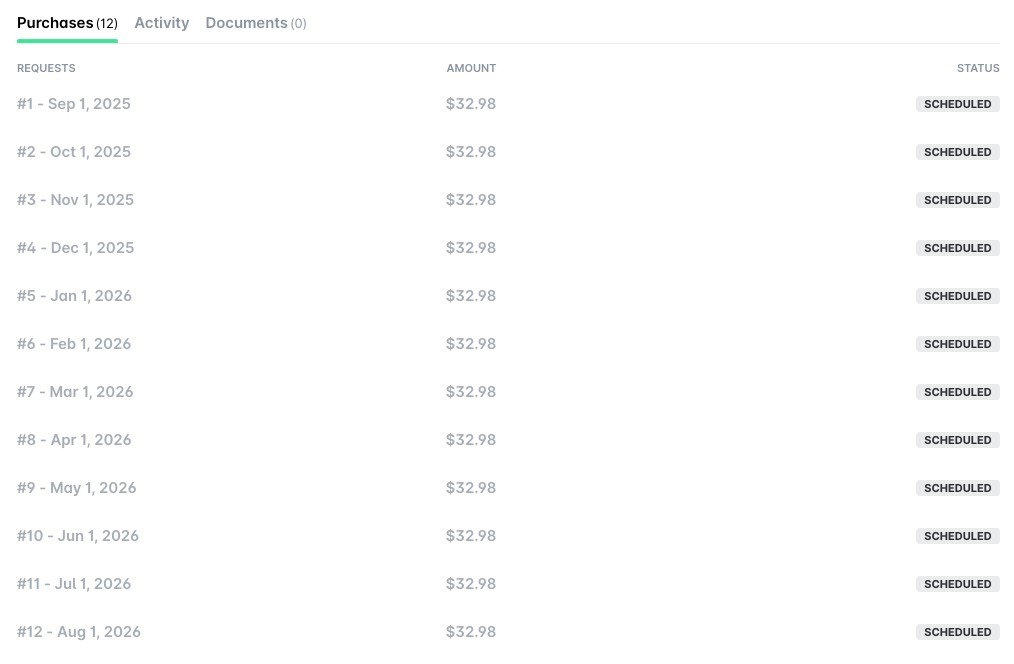
Each recurring request will contain request instances scheduled for each recurring period. For example, if the recurring request is set to a monthly recurrence over a year, it will contain 12 request instances (scheduled requests) that will be automatically opened by the system each month on the specified date.
Request instances cannot be managed individually; they must be handled through the recurring parent request. For example, if the supplier changes the item prices midway through the recurring order, you can edit the recurring parent request, update the prices, and resubmit it for approval. Request instances created before the price change (if any) will retain the old prices, while future and open (not yet invoiced) request instances will reflect the updated amounts.
You can manage recurring requests in the same way as one-time requests, including editing or deleting them. However, you can add invoices and receipt notes to their request instances only.
If Payhawk’s Procurement AI Agent is enabled for your company, you can easily create and submit requests using its powerful capabilities and conversational experience, all within your company’s conversational channel. To confirm availability, check with your company’s Payhawk Administrators.
Specifics
Each request instance will be opened on its scheduled date, thus appearing under Requests > Receive or Invoice according to the request type settings.
Request instances automatically inherit the details of their recurring parent request, including items, amounts, supplier information, and other relevant details.
Each request instance inherits the description and details of the recurring parent request, with a suffix appended to its scheduled date to indicate its sequence.

You can create and submit recurring requests that began in the past. For example, if you made a payment and received the receipt note last week but are only now logging it into the system, a child request will also be generated for the relevant past date.
You can duplicate a recurring request, where the new request keeps the recurrence settings of the original one.
Creating recurring requests
To create a recurring request:
In the Payhawk web portal, go to Requests.
Click on the + New button.
In the dialog that opens:
Select the type of request.
(Mandatory) Fill in the Description field providing information you consider important for approvers and reviewers to know.
Attach a document for your recurring request, for example, a supplier quote. Payhawk's automation tool will automatically extract the request data and fill in the information in the respective fields upon creating the request.
Click on Continue. As a result, the request will be created.
Fill in the information included in the Request details section.
In the Supplier field, choose the company from which you want to request the goods or services.
To create a recurring request:
Go to Recurrence, click on Edit, and select the period for which a new request instance will be opened, for example, Semi-annually.
Under From and To, select the start and end date, respectively, of the recurring request, for example, 2 years from the current date.
In Payment method, select among the available payment methods for the request:
Card indicates the request will be paid with a card and that it can be later on linked with a card expense only. Here you can either select to pay the requested items with a card already assigned to you or you can choose the Single-use card option.
If you choose to pay with a card assigned to you, the card will be topped up with the requested amount when the request is approved.
If you select to pay with a single-use card, it will be issued in your name automatically when the request is approved.
Bill indicates it will be paid via bank transfer and that it can be later on linked with a bill expense only.
No payment needed indicates the request doesn't need to be paid for, as the requested goods are in store, for example.
If Payment method is not a required field, you haven’t defined a value for it (None), and the settings defined by a Payhawk Administrator at your company allow it, you will be able to link expenses of any expense type to that request.
To edit the payment method, click on Edit, update the information, and click on Save.
The Special instructions field will be visible only if you are requesting a purchase order. Enter any special instructions you want the approvers or reviewers of the purchase order to see.

Fill in the information included in the Additional information section. It will contain fields that were set as required for the request type by a Payhawk administrator at your company.
Fill in the information included in the Amount section.
To add new items, click on the Add new item button.
If you are not interested in the item details but rather in the amount only, click on Remove item details. As a result, a filed showing only the aggregated amount of the requested goods will be displayed.
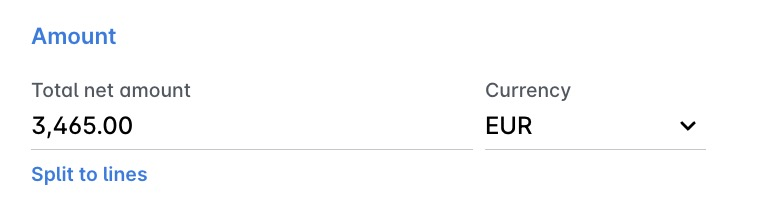
From the screen with the amount only, you can add the details for each item by clicking on the Split to lines option. In the dialog that opens, choose whether you want to add the items manually or from the attached document (if any).
Manual split will result in opening an empty item row where you can add the item details.
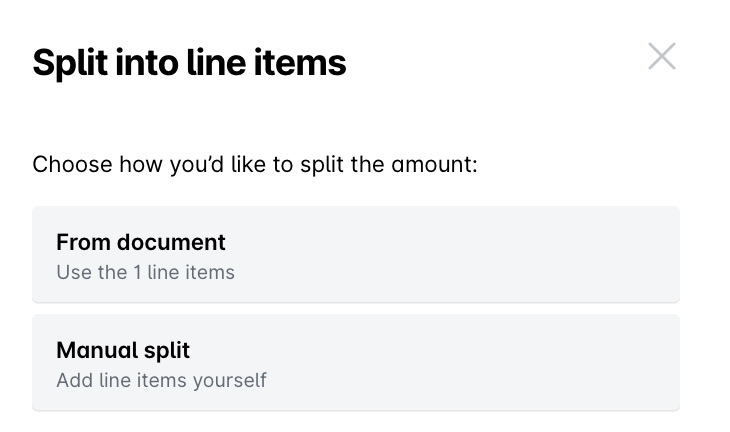
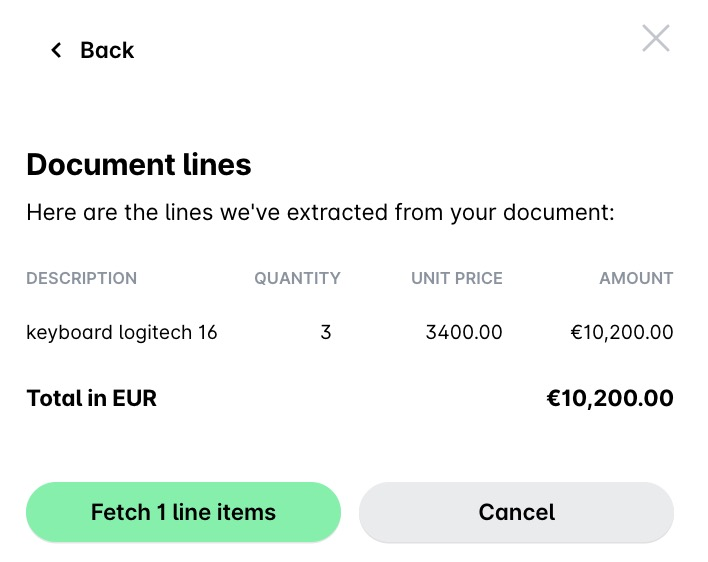
From document will show the lines detected form the attached document. To confirm you want the system to fetch and replicate them in the request, confirm by clicking on Fetch [number] line items.
If you have uploaded a request document (for example, an invoice), you can also use the Split by document lines option. As a result, Payhawk AI will replicate the rows of the invoice, extract the data from the document, and automatically fill in the available information related to each requested items.
If the request type has been associated with categorisation fields, scroll the Amount table to the left and enter the information where needed.
Based on the provided information, Payhawk will create the request instances for the period you specified.
To submit the request, click on Submit.