Employees in Germany are entitled to per diems to compensate for the additional costs of meals and accommodation incurred during business trips. These per diems are not considered part of an employee’s regular salary and are therefore tax-free up to a legally specified limit. In Germany, per diem expenses are calculated using daily-based rates.
Deductions
If the employee receives a free meal, it must be deducted from the per diem allowance. For example, this applies if the hotel provides a complimentary breakfast. These deductions apply only to the meal portion of the per diem. The overnight stay allowance is paid in full for every night and is not reduced by provided meals.
Here are the standard deduction rates for provided meals:
20% of the full day rate must be deducted if breakfast is provided.
40% of the full day rate must be deducted if lunch is provided.
40% of the full day rate must be deducted if dinner is provided.
Specifics
The following guidelines outline important details and special cases related to per diem allowances, business travel durations, documentation requirements, and tax-free reimbursements in Germany.
If an employee undertakes multiple business trips within the same calendar day, the total hours from all trips can be combined.
If a day includes both domestic and international travel, the whole day is paid at the international rate for the last destination reached. Whether it counts as a full day or a half day depends on the total time away, not on the hours spent abroad.
All expense invoices must be issued to the company’s corporate address. For invoices exceeding 150 EUR, they must also include the employer’s name, address, and the applicable VAT amount.
All original expense documents, such as receipts and invoices, must be stored, either physically or digitally, within the EU.
Domestic trips
For domestic business trips, per diem rates are determined by the length of the trip, which is measured by the total time the employee is away. It does not matter whether the trip begins from the employee’s home, primary workplace, or another work location.
For example, an employee is traveling from Berlin to Stuttgart in Germany and has filled in the following trip details:
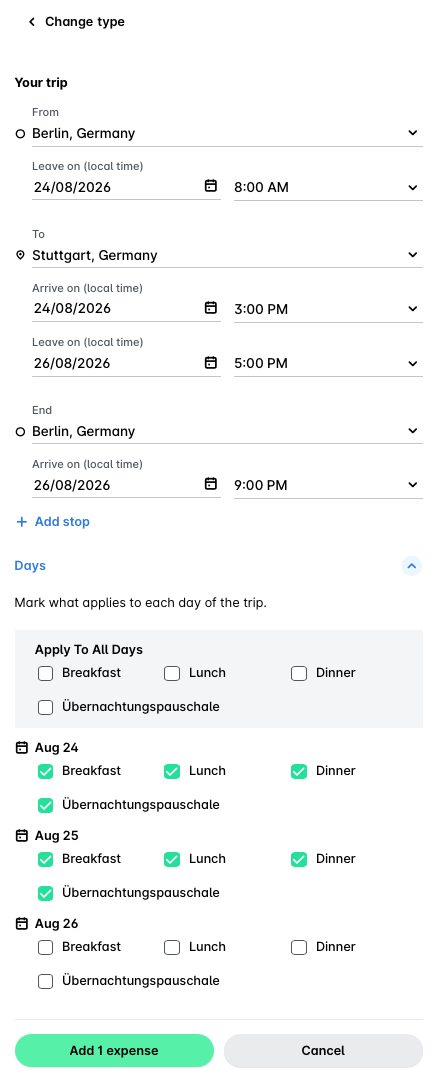
In the Payhawk template, based on the data entered by the employee, the corresponding columns will be populated in the following way:
Destination. Germany
Destination code. DEU-Stuttgart
Currency. EUR
Half day. 14
First/Last day. 14
Full day. 28
Breakfast. Lunch. Dinner. 5,6. 11,2. 11,2.
Overnight stay allowance (Übernachtungspauschale). 20.

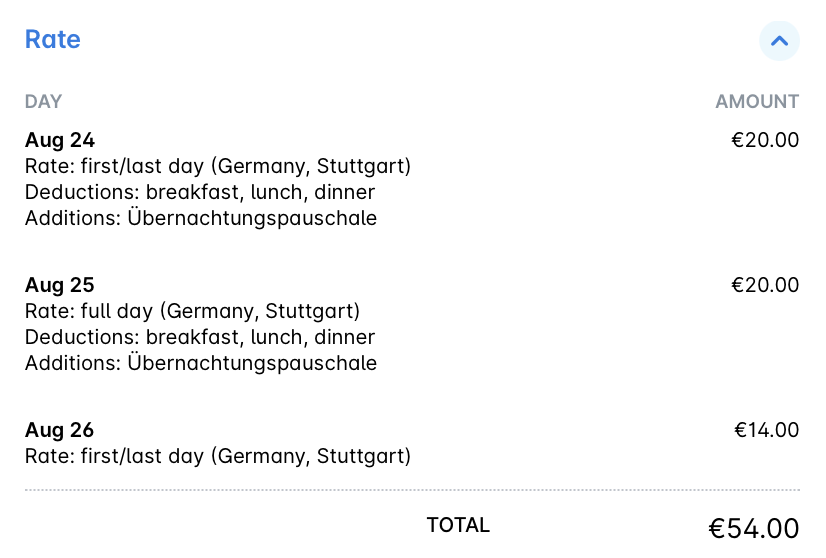
In this case, the system calculates the rates in the following way:
Trips abroad
When employees travel internationally, different regulations apply. The per diem allowance depends on the specific destination country.
The rates are defined in a regulation based on the German Income Tax Act.
For example, an employee is traveling from Berlin, Germany to London, the UK and has filled in the following trip details:
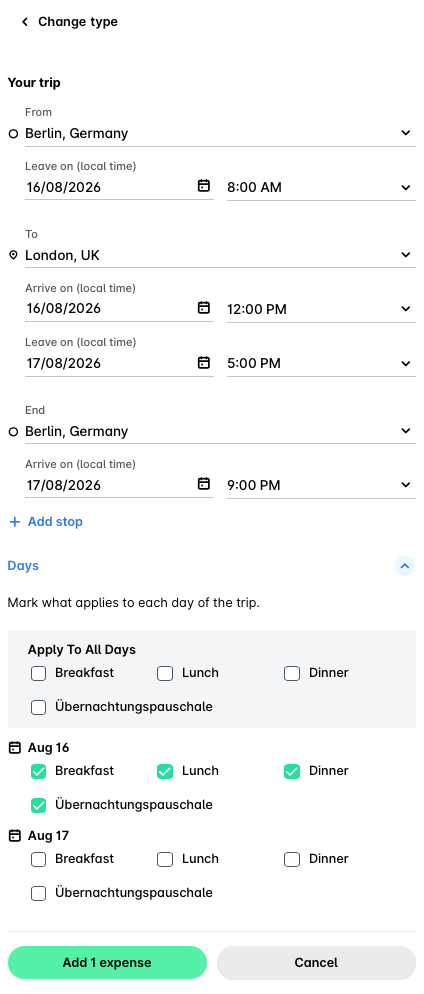
In the Payhawk template, based on the data entered by the employee, the corresponding columns will be populated in the following way:
Destination. United Kingdom
Destination code. GBR-London
Currency. EUR
Half day. 44
First/Last day. 44
Full day. 66
Breakfast. Lunch. Dinner. 13,2. 26,4. 26,4.
Overnight stay allowance (Übernachtungspauschale). 163.

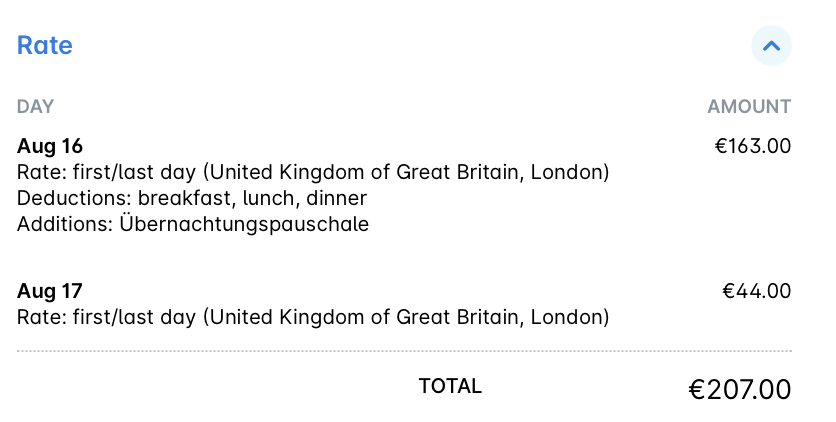
In this case, the system calculates the rates in the following way:
Useful resources