Why connect spend management to DualEntry
29 Sept 20269 min


AI-first finance tools promise productivity but often add risk, noise, and manual review. AI-native systems take a different approach by embedding AI directly into controlled workflows, where policy, auditability, and delegation are built in. Learn why CFOs should care about the difference, and why AI only scales in finance when it makes work safely delegable, not just easier to talk about.

By submitting this form, you agree to receive emails about our products and services per our Privacy Policy.
The current wave of AI in enterprise software is drifting into the same trap: Teams are shipping AI because it is expected, not because it improves the work. In finance, that mistake becomes obvious fast. Finance adopts tools that are fast, predictable, and auditable. Anything that increases ambiguity becomes a tax, even if it demos well.
An AI layer that adds latency and ambiguity is just overhead. And finance will pay for it once, then switch it off.
LLMs are capable enough to be useful in finance; that part is settled. What isn’t settled is how vendors are embedding them into workflows. Most products are taking the easiest path: Add a chat surface, label it “copilot,” and assume that conversational access equals productivity.
That approach confuses a new interface for a new operating model. It also treats finance work as if it’s mostly about answering questions, when it’s mostly about executing decisions under constraints. The hard part in finance isn’t finding answers, but making decisions safe to delegate.
When AI is treated as a layer on top of the product, the user inherits the complexity. They have to prompt, interpret, verify, and then manually carry the output into the real workflow. That’s why people feel like they are drowning in AI features they never asked for. It’s not that the model is bad; it’s that the product has not actually removed work.
Orchestrate finance with ease & efficiency: Meet the agents

AI-first UX is what you get when AI becomes the starting point of product design. The question becomes, “Where can we put AI?”
And the result is usually an assistant that talks, summarises, drafts, and suggests, while the core workflow remains largely unchanged. It is retrofitting, not redesign.
AI-native UX starts from a different question: “What outcome must be delivered, under what controls, with what auditability, and what exceptions are allowed?” AI is then used to make that outcome achievable with less operational load. In an AI-native system, the workflow is the product, and the AI is embedded in how the workflow executes.
In finance, reliability beats cleverness every time.
Finance exposes AI-first weaknesses because finance has constraints that most software categories can ignore.
First, finance has many deterministic moments. Approval routing, budget checks, policy enforcement, payment execution, posting rules, and audit evidence are not areas where “pretty close” is acceptable. Replacing those moments with probabilistic behaviour introduces risk and rework.
Second, the downside is asymmetric. A wrong answer in a generic copilot is annoying. A wrong payment, a policy bypass, or a missing audit trail creates real damage and real-time cost. This changes the threshold for trust.
Third, finance work is a chain across systems, not a single screen. Spend touches travel, cards, invoices, procurement, ERP, and banking rails. If AI cannot move the chain forward within controls, it becomes another tool that generates text while humans still handle coordination.
This is the heart of why AI-first tools disappoint. They help you talk about work, but they don’t help you delegate work.
If you want AI to scale in finance, treat it as a delegation problem. The core job is to make work delegable within the boundaries that finance teams already run on.
Start with a bounded workflow with clear inputs and outputs: a specific request-to-approval-to-payment path, or invoice capture-to-approval-to-posting, where you can name the control points and common exceptions.
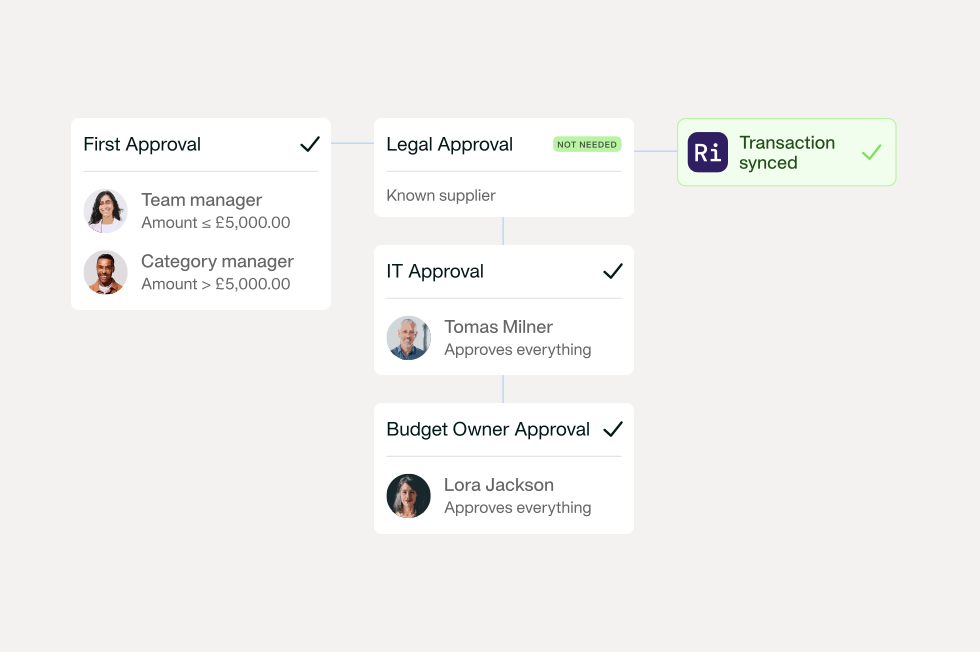
Then make policy executable. Policies that live in documents don’t scale; they need to exist as enforceable rules: Thresholds, categories, required fields, budget owners, routing logic, and exception handling.
Next, let AI gather context and prepare actions. This is where LLMs earn their keep. They can extract and normalise messy inputs, classify spend, propose coding, detect missing data, and draft the next best action for the workflow. The key is that this preparation happens inside a governed system, not in a free-form chat that the user has to translate into steps.
Then require human confirmation only where risk is real. Routine cases should flow smoothly, and exceptions should be escalated. You only reduce operational load when routine cases run through cleanly, and humans handle the edge cases.
Finally, make the system observable. If AI touched a decision, it needs a trail: Who approved what, what rule fired, what data was used, what exception occurred, and what the final outcome was. The trust mechanism is a clean trail. If you can’t replay the decision, you can’t scale it.
The word “agent” is being used loosely. In serious finance systems, an agent is not defined by how well it talks. It is defined by what it is allowed to do and how it escalates when it can’t do it.
A real agent has a scope, permissions, control points, and accountability boundaries. It can execute within those boundaries, and it can stop and route when it hits an exception. A chatbot that drafts messages is not an agent, but a writing tool.
This is why role-shaped agents matter in finance. Finance work naturally decomposes into roles like travel, procurement, payments, and financial control. When agents map to these roles, you can define what “done” means, what “allowed” means, and when a human must step in. Without that structure, “agent” becomes another name for a conversational interface.
AI-first products need to prove they have AI, so the AI stays visible. The interface becomes full of prompts, panels, suggestions, and conversational entry points. It’s performative because visibility is the proof.
AI-native products do not need to prove they have AI. They need to prove they remove work. That tends to produce a quieter interface because the AI runs in the background, preparing actions, enforcing rules, and routing work. Users see fewer steps, fewer chases, and fewer surprises. They only engage when a decision is needed.
A useful rule of thumb is this: If the AI must constantly explain itself to justify its presence, it is probably doing too much in the UI and too little in the system. In finance, the best AI is often the AI you barely notice because what you notice is that the workflow moves.
Most AI playbooks assume maturity is linear: pilot, rollout, scale. Finance teams experience it differently. They stall when the operating model cannot absorb delegation.
Teams get stuck in the middle when ownership is unclear, exceptions are unmanaged, approvals are inconsistent, audit trails are incomplete, and policy remains descriptive rather than executable. At that point, adding more AI does not help. It increases the number of AI-influenced moments that need review and control.
So maturity is not about adding capabilities. It’s about increasing delegation capacity. AI-native design increases delegation capacity by turning policy into execution and making exceptions tractable. AI-first design usually does the opposite, increasing ambiguity and pushing coordination back onto humans.
The next step in AI for finance is operational delegation. That means policies that execute, workflows that route and escalate, audit trails built in, and agents that behave like bounded operators rather than talkative assistants.
AI-first makes the interface feel smarter. AI-native makes the organisation run faster, with fewer chases and fewer surprises. Finance teams will choose the second, even if it looks less flashy in a demo.
If you want AI that actually takes work off your plate, start with agents built for finance workflows. See how role-based agents delegate work inside policy and controls.
Georgi Ivanov is a former CFO turned marketing and communications strategist who now leads brand strategy and AI thought leadership at Payhawk, blending deep financial expertise with forward-looking storytelling.