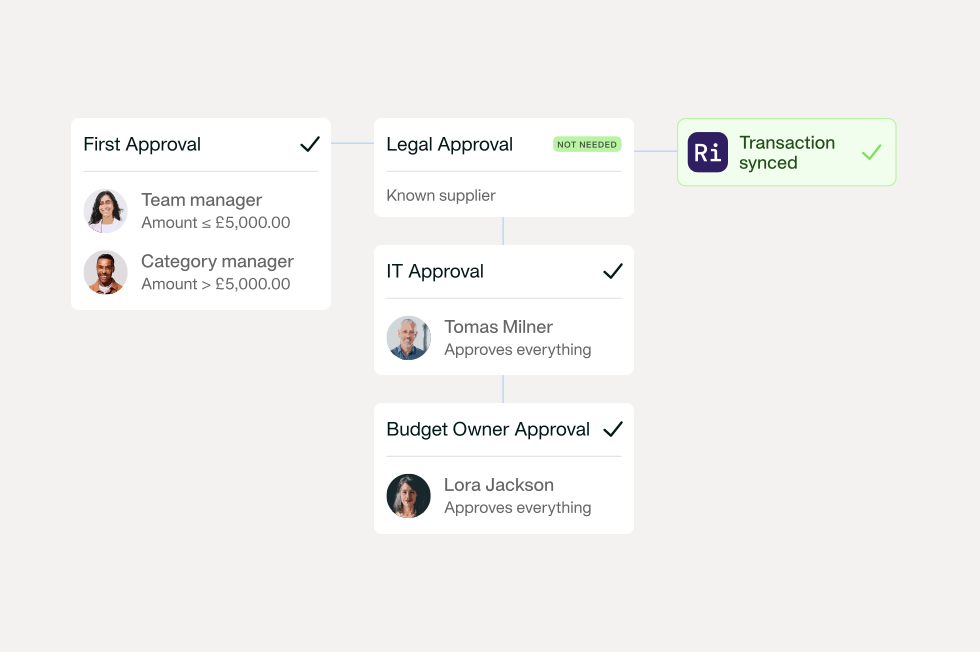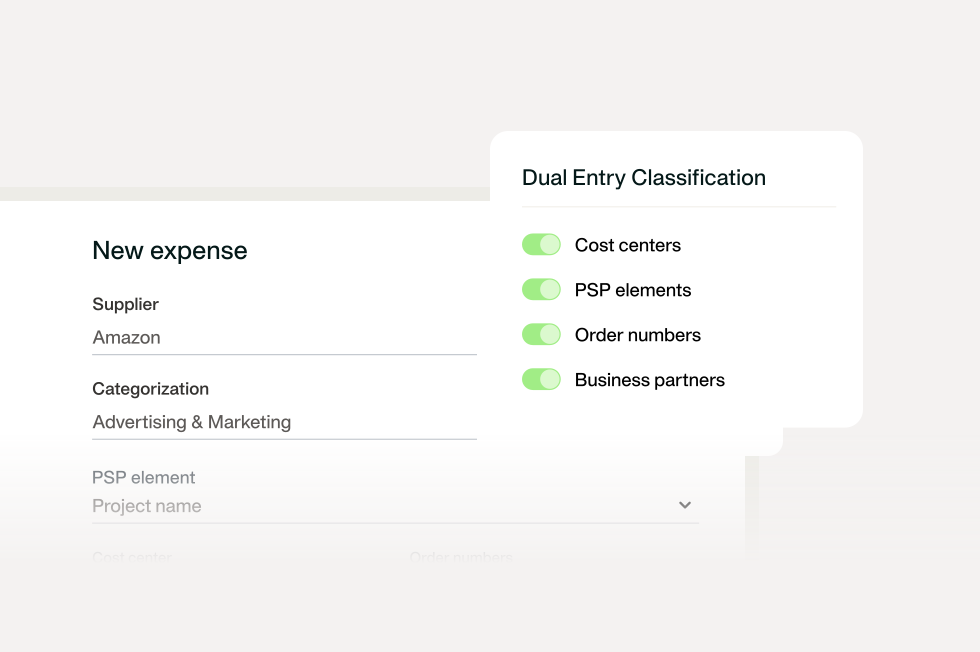
Why connect spend management to DualEntry
29 Sept 20269 min


Manual travel management doesn’t fail because booking is hard. It fails because finance control, spend visibility, and reconciliation sit outside the booking flow. The goal is simple: Compliant travel spend, with no surprises. That’s why finance teams are driving businesses to move toward AI-native travel (to not only book faster, but more importantly, to make policy, approvals, payments, and data work as one system from the start).

By submitting this form, you agree to receive emails about our products and services per our Privacy Policy.
Finance teams didn’t wake up one morning and decide they needed a new way of managing travel. What changed is simpler: as businesses grew, manual travel management just stopped holding up.
In many organisations, travel is still coordinated through people rather than systems. Sometimes employees book trips independently. In other cases, bookings run through Ops teams or an external travel agency. But in every setup, policies, approvals, and spend visibility tend to sit elsewhere, so finance only sees the impact after the trip has already happened.
Put yourself in the shoes of your sales lead, Gemma, for a moment. Gemma is travelling to a client meeting. She’s thinking about her passport, her gate, and how to get to the hotel on time. She’s booking quickly, often at the last minute, under pressure. What she is not doing is cross-checking policy documents, approval thresholds, or preferred supplier rules.
And that’s not a failure of discipline. It’s a reality of how people travel.
This is where finance gets unstuck. Traditional travel programmes assume behaviour that doesn’t exist at scale. They rely on people to slow down, interpret policy, and make “correct” choices in moments designed for speed. The result is predictable: Spend that technically followed a process, but escaped control.
AI-native travel works because it removes that dependency. Instead of asking employees to think like finance, it makes compliant choices the default within tooling and enforces policy in the moment decisions are made.
But what about after the trip? Even if the trip’s been booked within policy, if it’s been booked on a separate platform or with a personal card, then the spend won’t be seen or accounted for until after the money’s left the business.
That’s the real issue. When spend is only visible after the fact, finance isn’t governing travel spend. It’s auditing it. Budgets become historical records, approvals turn into clean-up work, and reporting becomes damage control. At scale, delayed visibility isn’t an inconvenience. It’s a loss of economic control.
Boris Angelov, Principal Product Manager at Payhawk puts it simplly:
Finance needs travel to run as one controlled flow: approve, book, pay, and reconcile, without jumping between tools or chasing data later.
Orchestrate finance with ease & efficiency: Meet the agents

Controlled travel management (and spend) only scales when approval, booking, payment, and reconciliation happen in one controlled flow.
The problem isn’t actually booking. It’s everything around it. What finance teams are moving toward isn’t just another booking tool. It’s a model where policy, approvals, payments, and data work together as one system, in real time.
The two most common problems finance teams face thanks to manual travel management are:
Employees booking directly = Decisions are made quickly, often under pressure, and policy checks happen later, if at all.
Travel coordinated via a dedicated Ops team or an external agency = Booking may feel more structured, but the finance team's controls and approvals (and spend data!) still sit outside the flow.
The pain points differ across structures. But the outcome is the same: visibility and control arrive too late, and finance is left managing travel spend after decisions have already been made.
No matter the structure, most travel programmes aren’t broken at the point of booking. Flights are booked, hotels are reserved, and people get where they need to go. Beyond ‘booking,’ finance needs control across the full travel lifecycle:
In manually managed setups, these needs are handled through people and process. Think, policy documents, approval chains, follow-up emails, spreadsheets, and month-end clean-up.
And the manual programme technically works. But it creates friction, hidden costs, and unnecessary risk for finance.
AI-native travel flips the starting point. Instead of adding finance controls after the fact, it makes them foundational. Policies are understood by the system, enforced automatically, and produce finance-ready data by default.
If employees book independently, the admin shows up as receipt chasing and out-of-policy spend.
If bookings go through a travel team or agency, the friction shifts to approvals, coding, and delayed invoice data. Either way, finance ends up cleaning up after the fact.
Whatever way you book travel now, there is always the danger that when you review your program, your attention will go straight to ticket prices and negotiated rates. Those matter, of course — but in practice, the bigger drain is the time and effort spent cleaning up travel after the fact.
Finance teams recognise these pain points immediately:
None of this creates value. It’s the cost finance pays when spend visibility arrives too late to prevent errors, rather than early enough to stop them.
AI-native travel reduces this administrative load by connecting booking, policy enforcement, approvals, payments, and data into a single flow. Less manual intervention means fewer exceptions, earlier control, and a faster close because spend is governed before money leaves the business.
At scale, finance just doesn’t need more reminders, training, or escalation paths. It needs systems that apply policy automatically, record decisions as they occur, and involve humans only when judgment is required.
This is where AI-native travel changes the mechanics of control.
Instead of acting as a separate layer that reviews bookings after the fact, the system becomes the control surface itself. Travel requests are interpreted in context, checked against policy, budget, and role-based permissions, and executed only within those guardrails. Decisions are logged automatically, exceptions are surfaced immediately, and nothing relies on memory, follow-up, or goodwill.
This is also where trust in AI becomes practical rather than theoretical. The question for finance is not whether an agent is intelligent, but whether it is constrained. An AI agent is only trustworthy if it is rooted in the company’s policies, workflows, and approval logic, and if it cannot bypass them. When policy, approval thresholds, and payment rules are baked into the system, the agent does not “decide” freely. It operates inside the rules that finance already owns.
Organisations like the media and education company Paradox saw the impact of this shift immediately.
Before moving to Payhawk, booking travel at Paradox was a small project that required back-and-forth between teams, manual checks, and follow-ups. Spend was visible late, and the month-end involved days of chasing receipts and fixing errors. With AI-native travel, bookings happen in minutes, policy is enforced automatically, and receipts and approvals are handled as part of the flow. Finance doesn’t spend time explaining variance after the fact because the system prevents it upfront.
Farah Rouassi, VP Finance & Strategic Partnerships, explains: “I was used to having to create a mini project to book a flight and a hotel. On a good day, it took over one hour and a lot of back and forth with other stakeholders.”
The result is not just faster booking. It’s a change in how control works. Finance moves from chasing compliance to setting the rules once and letting the system enforce them consistently, at speed, and at scale.
Farah continues:
I booked something yesterday with the AI travel agent, and it was just four minutes… that’s over 90% faster! So quite huge!
The difference wasn’t faster booking alone. It was that policy, approval, payment, and data stopped living in separate systems.
AI-native travel does this by embedding policy directly into the booking flow. Compliant options surface first, approvals trigger automatically when thresholds are crossed, and exceptions are flagged in real time rather than discovered at month-end. Finance gains visibility and control without becoming a bottleneck.
Learn more about Farah's story in the short video below.
In an environment of tighter budgets and heightened scrutiny, month-end visibility arrives too late to influence outcomes. By then, spend has already occurred, exceptions have compounded, and finance is left explaining variance rather than shaping it.
By then, spend has already occurred, exceptions have compounded, and finance is left explaining variance rather than shaping it.
Manually managed travel programmes produce fragmented, delayed, and hard-to-reconcile data because visibility is assembled after the fact. AI-native travel generates structured, finance-ready information as travel happens, not after clean-up.
This isn’t about better dashboards. It’s about shifting travel from a retrospective reporting exercise to an active control system inside the reporting period.
Meanwhile, the traveller experience still matters — but “easy” must include finance
One reason manual travel models persist is that they often feel flexible or familiar to employees. But “traveller-friendly” doesn’t have to mean “finance-hostile.”
The best programmes today optimise for both:
Travellers want fast booking, fewer steps, and clear choices
Finance wants guardrails, clean data, and minimal admin
AI-native travel improves the experience for both sides by reducing friction at the source. When the system understands intent, automatically applies policy, and routes approvals intelligently, travel becomes easier for employees and more controllable for finance.
Control doesn’t have to come at the expense of speed.
For finance, travel isn’t finished when someone books. It’s finished when the spend is correctly paid, coded, reconciled, and auditable.
In manual setups, this is where complexity piles up:
AI-native travel supports a broader shift toward finance orchestration — connecting what employees do with how the business governs and records spend. When payments, approvals, and data are aligned at booking, the month-end becomes lighter, audits are easier, and finance teams spend far less time resolving exceptions.
There's a strategic reason many finance leaders start with travel. It is high-frequency, highly visible, and relatively contained, which makes control failures easy to see and improvements easy to measure.
When travel is governed through a modern system, finance typically sees faster approvals, fewer out-of-policy bookings, cleaner data for reconciliation and reporting, and materially better visibility into spending patterns, often within the first reporting cycles. These gains are not incremental. They demonstrate what effective spend control looks like when policy, approval, payment, and data are aligned.
That's why travel often becomes the entry point for broader spend governance. It allows finance to modernise control in a bounded domain, prove the operating model, and then extend the same principles across cards, expenses, and procurement, without attempting a disruptive, all-at-once transformation.
As AI-powered travel solutions multiply, the risk for finance isn’t a lack of choice. It’s choosing something that looks smart on the surface, but doesn’t deliver real control.
The right fit will depend on where your travel programme sits today, whether employees book directly, or travel is managed through Ops or an agency. But the standard stays the same.
For CFOs, the question is whether the system can hold up under scrutiny, scale without leakage, and generate finance-ready data by default.
Use the criteria below as a practical checklist. If a solution falls short in any one area, it will create more exceptions, clean-up work, and cost as volume grows.
Trust is the final hurdle for any autonomous system in finance. The question is not whether AI can act quickly, but whether it can act before decisions are locked in. For CFOs, trust does not come from intelligence alone. It comes from visibility and constraint.
Your wider business may celebrate the efficiency an AI agent delivers, but you know it is only reliable if it operates within the company’s policies, approval logic, and workflows, and if finance can see and verify decisions as they happen, not after the fact.
Boris Angelov, Principal Product Manager at Payhawk, describes:
AI agents never skip a line from the policy or make exceptions.
That distinction matters. It reframes AI from a “decision-maker” into an execution layer that applies rules finance already owns, consistently and in real time.
And this is the real “aha” behind AI-native travel. Manual travel management fails not because people ignore policy, but because spend visibility arrives after decisions are made. Once that happens, trust is already lost. Finance is no longer governing travel; it’s explaining it.
AI-native travel changes that dynamic by making policy, approvals, payments, and data operate as one system at the moment a booking is made.
At Payhawk, our AI Travel Agent does not optimise freely or improvise. It retrieves the relevant policy, budget limits, and role-based permissions instantly, applies them during booking, and records the decision as it happens. Preferences are learned only within those guardrails, ensuring convenience never overrides control.
Boris explains: "Your agent is only as good as what you feed it. Clearly defined policies and structured workflows aren’t optional. They’re essential."
When those foundations are baked in, trust becomes operational rather than theoretical. Finance no longer has to supervise every transaction, chase compliance at month-end, or explain variance after the fact.
Control is enforced by design. Visibility is immediate. And decisions are governed within the period, not audited after it. That’s why travel has become the proving ground for modern finance orchestration and why the same operating model can extend far beyond travel itself.
Boris confirms:
Compliant travel spend. Instant visibility. No surprises. That’s what finance-led travel control looks like!
See how finance-led, AI-native business travel works in practice, from request and approval through to payment and reconciliation.
Trish Toovey works across the UK and US markets to craft content at Payhawk. Covering anything from ad copy to video scripting, Trish leans on a super varied background in copy and content creation for the finance, fashion, and travel industries.