Why connect spend management to DualEntry
29 Sept 20269 min


Spend management breaks at scale when control is applied after money moves, not before. For finance directors, that means rising risk, delayed decisions, and visibility that arrives too late to matter. This article explains how, with an orchestrated spend management platform and ERP-grade controls built into every step, you and your finance team can enforce policy, maintain audit-ready oversight, and scale without adding headcount.

By submitting this form, you agree to receive emails about our products and services per our Privacy Policy.
Spend management breaks at scale when control happens after money moves, not before. That’s when finance becomes the backstop for every exception, every missing record, and every “we’ll fix it later” moment.
If you’re a Finance Director in a mid-sized or enterprise organisation, this shows up fast. Spend spreads across teams, entities, currencies, and tools. Visibility arrives at month-end. Policy gets enforced inconsistently. Audit evidence lives in inboxes. And the more the business moves, the more finance has to catch it.
The shift is moving from manual work and disconnected tools to automation and finance orchestration. An ERP-grade spend management platform like Payhawk runs requests, approvals, payments, and accounting in one controlled flow, so finance keeps ownership and visibility before money leaves, not once the clean-up starts.
A quick example: Global insurance organisation, Aventum Group, hit this wall while scaling across 11 entities and multiple currencies. Expenses were submitted via spreadsheets and PDFs, approvals happened over email, and finance was correcting data in NetSuite after the fact. The problem wasn’t only speed. It was that control and auditability depended on people remembering to do the right thing. In the sections below, I’ll use Aventum as a reference point for what ERP-grade spend management looks like in practice, from real-time visibility through to approvals, payments, and audit trails.
Orchestrate finance with ease & efficiency: Meet the agents

This is for finance leaders responsible for governing spend across a growing, increasingly complex organisation.
You’re accountable not just for processing transactions, but for ensuring spending decisions are controlled, auditable, and defensible across teams, entities, and systems. As volume and complexity increase, the risk isn’t that work gets slower. It’s that visibility arrives too late, policy is enforced unevenly, and finance ends up correcting issues after money has already moved.
If spend feels harder to govern than it used to, it’s usually not because people are careless. It’s because the operating model no longer holds at scale. This article is for finance leaders who want control to be built in by default, not patched on at the end.
The good news: This isn’t another budgeting article. It’s a practical guide to redesigning how spend is governed as your organisation scales.
You’ll learn how to move control upstream, so finance enforces policy, budgets, and approvals before money moves, not after issues surface. You’ll see how to keep spend visible in real time across teams, entities, and ERPs, without adding headcount or manual checks. And you’ll understand how to reduce audit risk by making every decision, approval, and exception automatically traceable.
Specifically, this article shows how to:
When your business is just starting, spreadsheets and company cards are an easy way to balance the books. At scale, however, they shift accountability to individuals and push control downstream, resulting in inconsistent enforcement and delayed visibility.
But as your company scales, what were once efficient tools become costly bottlenecks. Here are some signs it’s time to move on:
Sign #1: Late accruals and reconciliation delays
The month-end deadline looms, and manual entries and errors push the close out over several days. The team has to block their calendars entirely — everything else gets deprioritised — just to keep up. Reports arrive late, and directors scramble to verify accuracy, a clear sign of constant firefighting.
Sign #2: Rogue SaaS renewals and unmanaged spend
When you don’t know which subscriptions you’re paying for — or where your spending actually goes — your departments end up managing you. Duplicate subscriptions renew quietly, costs spiral, and fragmented systems make true visibility impossible.
Sign #3: Fragmented data and a lack of visibility until month-end
Spreadsheets isolate data across teams, leaving you without real-time insight - if any at all. As the owner of the numbers, you’re forced to wait until month-end to understand spend, long after proactive decisions could be made.
Sign #4: Endless receipt chasing and policy confusion
Constantly chasing missing receipts and clarifying expense policies wastes time and erodes morale.
These issues often start small, but once a company reaches a certain size, they multiply — more teams, more entities, more spend, and far less visibility. What was once manageable quickly becomes a drag on finance and operations.
That’s why mid-sized companies and enterprises turn to flexible spend management solutions that scale with growth, providing real-time visibility and precise control.
As Tim Green, Head of Finance Transformation at Aventum Group, explains:
As we scale, we need systems that scale with us; automation, consistency, and visibility across every entity.
Once spend reaches a certain volume and complexity, finance leaders stop asking how to process transactions faster and start asking how to stay in control without slowing the business down.
And that’s the moment spend management stops being a tooling problem and becomes an operating-model decision about control, delegation, and accountability.
At that point, the question is no longer “how do we automate this?” It’s “how does authority actually flow through finance?”
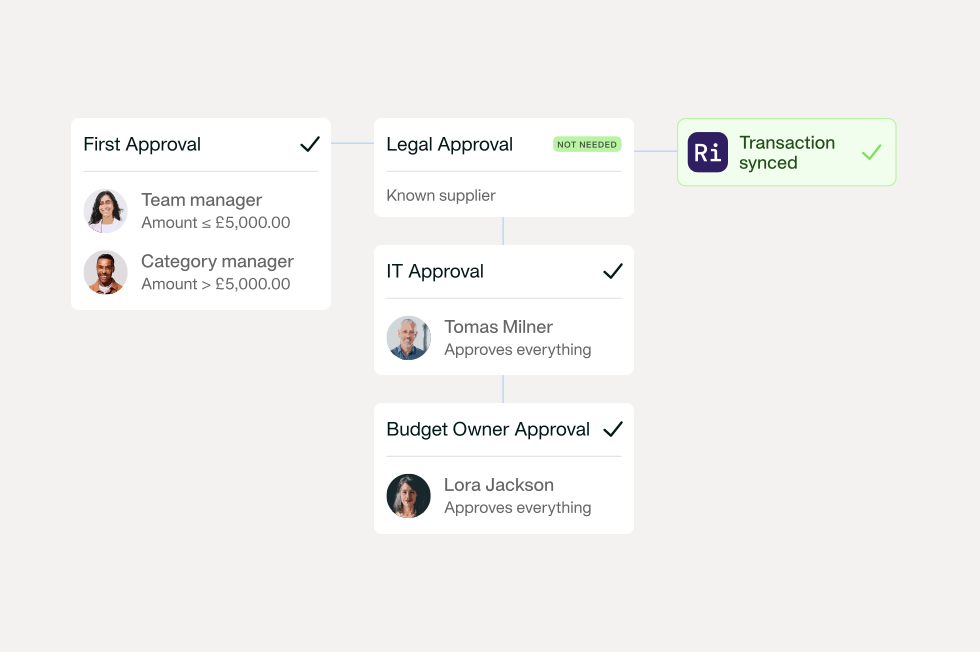
An ERP-grade spend management platform doesn’t just automate tasks. It defines how approvals, budgets, and accounting decisions are enforced in practice — so work can move forward without losing auditability or ownership.
With the right tool, you get:
When your finance team leaves core tasks to fix reconciliations and handle admin work, it drags you further from your goals. This manual workload compounds errors and losses.
An ERP-grade spend management platform automates repetitive tasks while reducing errors. Your team can then reclaim time and focus on higher-value work. For example, with our platform, you’ll access:
Finance teams revolutionise their processes with these systems:
Tim Green at Aventum says:
We no longer have to chase receipts. Since using Payhawk, everything is automated — from card spend to reconciliation
Concerning stat: 85% of professionals say regulations have become more complex over the past three years. Inadequate tools make many finance teams struggle with audits. Think emails and spreadsheets. The result is incomplete paperwork, sluggish approvals, missed deadlines, and process overload.
Proactive compliance and spend control eliminate these issues. They centralise policy enforcement, accelerate approvals, and create live, audit-ready records in a single place. These features strengthen governance and reduce risk. For instance, you can improve oversight and compliance with our spend management platform and multi-entity management software:
The value is clear in our clients’ upgraded oversight:
Tim describes:
The PO features have given us a lot more visibility and control. We know exactly what’s approved and what’s pending
Closing the books on time can feel out of reach when finance teams juggle fragmented systems and delayed data. Without data integration across subsidiaries, spend visibility decreases, slowing reporting and strategic decision-making. That’s why streamlining spend insights from all corners of your organisation is critical. Take our integrations, for example, you’ll gain:
Here’s what our client had to say about our powerful financial system integration:
Tim at Aventum explains:
Now every expense flows seamlessly into NetSuite
If you’ve ever missed a duplicate spend or a team’s blown budget, you’re not alone. When your ERP, payment, accounting, and HR solutions don’t communicate with each other, it creates blind spots. It also fuels mistakes and weakens spending control. Research shows:
36% of leaders are extremely or very concerned about their company’s spending
65% of businesses say accessing ERP data is difficult
82% of companies work with stale data
That’s why building a single source of truth matters in spend management for mid-size companies and enterprises. It provides you with timely insight into spending across all entities. This feature enables you to manage transaction data with precision. You also gain the clarity to spot opportunities and risks fast.
Here are some ways our platform brings your data into one view and boosts ERP sync accuracy:
Businesses like yours are benefiting from time savings and accuracy boosts firsthand:
Tim says:
The reconciliations that used to take hours happen automatically.
Once spend data is clean, connected, and reliable, the next question is how that information is used to control money as it actually leaves the business.
Many FP&A teams try to make do with outdated processes. This approach bogs them down with low-value work, leaving little time for growth-driving analyses. Financial analysts spend nearly half of their time on data collection and validation. Also, only 8% of FP&A teams can create out-of-cycle forecasts easily.
Accurate insight into budgets and forecasts is key to business agility and optimal resource allocation. Here’s where an ERP-grade spend management platform shines. It provides your team with accurate insights. From here, you'll prevent errors and accelerate data-driven decision-making. Our spend management platform empowers your team with:
These systems give finance teams more time for strategic tasks:
Tim at Aventum Group:
Now, we can review T&E and easily compare last month’s spend across entities.
You may be wondering how to make the case for investing in a spend management platform. Its benefits are crucial to achieving your business goals. It:
Efficient expense management is another key advantage you gain from adoption. Customisation within expense management software also plays a vital role. It equips your finance team to tailor approval workflows and set unique spend categories. Plus, you can adapt processes as the business evolves.
The best systems allow your staff to track, submit, and approve expenses quickly. Here’s where automation comes in. It manages these tasks without requiring manual effort from your team. For finance directors in charge of spend management and expense management for mid-sized companies and enterprises on our platform, this translates to:
Having this round-the-clock support will make your team efficient.
Aventum Group
"As a growing insurance org with 11 entities, Aventum needs systems that scale with us... and Payhawk has helped us scale — plus it's easier to spot cost-saving opportunities to help the bottom line!"

This isn’t a software rollout. It’s a decision about how spend authority is delegated, enforced, and audited across the organisation.
And now that you know why investing in an ERP-grade spend management platform is important, the next question becomes: how do you ensure successful adoption? Let’s break down the steps.
Start by identifying one entity or department burdened with manual tasks. For instance, a finance team spending 40% of its time on manual expense processing is a prime candidate. Focusing here builds momentum and delivers a measurable impact early.
Ask:
Set clear spend policies, map costs precisely, and thoroughly test ERP synchronisation. Define spend categories and limits. Then, assign approvers aligned to business units to ensure smooth financial system integration. Here’s why:
Test real-time reconciliation during the pilot phase. Track:
These KPIs and actions will help you spot bottlenecks, discrepancies, and training needs for a smooth transition.
Simplify user onboarding by automating access setup according to role and seniority. Deploy paperless, customisable templates for tasks like expense submissions and invoice processing. This approach creates consistency and efficiency.
For instance, you can leverage our accounting template builder to create and customise export templates quickly. This way, expense and payment data fit your organisation’s needs. Our mobile app also provides a standardised and customisable expense form.
Additionally, set distinct budgets by business unit and use automated approval workflows to enhance spend control.
Once set up, monitor these KPIs to drive continuous improvement and compliance:
ERPs record transactions well. Cards enable spending. But neither enforces how decisions should flow across requests, approvals, payments, and audit. That gap is where risk, rework, and exceptions accumulate.
It’s easy to think your existing ERP and disconnected corporate cards cover all your spend management needs. However, many lack real-time spend visibility and control, leaving their company vulnerable.
An ERP-grade spend management platform fills these gaps, keeping users ahead. Here’s what some mid-market companies achieved using our platform:
German automotive giant, ATU transitioned to a cashless system across more than 500 branches using our corporate cards and expense management solution. They saved millions by recovering €2 million in VAT. ATU also reduced manual receipt chasing with automated reconciliations and improved budget control with instant spend visibility
London-based finance company, Essentia Analytics, cut its month-end close from ten to five days. This change allowed them to reallocate 50% of a finance team employee’s time from manual tasks to revenue-driving activities. Also, they now have 100% spend visibility with zero reentry errors.
International digital events organisation, GDS Group, replaced manual spreadsheets with our corporate cards, mobile receipt capture, OCR, automated coding, and ERP integration. These solutions reduce coding expenses by over 15 hours per month. They also saved non-finance teams 10 hours by reducing expense queries. Live tracking by project codes improved ROI analysis, allowing the finance team to manage costs proactively
Selecting a spend management platform that aligns with your company’s specific needs is crucial. Use this checklist to evaluate potential vendors’ capabilities:
Expense management focuses on employee-initiated costs like travel and office supplies. Its admin involves tasks like organising expense data, tracking approvals, and reimbursements. Spend management takes a strategic view of expenditure, including procurement and supplier management. Common tasks include optimising budgets, executing payments for due invoices, and cost control.
ERP integration timelines depend on your existing setup and the chosen system’s complexity, but typically range from 2-8 weeks.
Purchase orders aren’t always mandatory. They’re most valuable for strategic or high-value purchases, where structured approvals and budget controls matter most. For day-to-day spend, teams benefit more from fast, visible approvals that maintain oversight without slowing work down.
Yes. Our spend management platform offers flexible policy automation. Control budgets by team, project, or merchant to enhance financial process automation.
Adopting a purpose-built expense and spend management platform is a game-changer. This technology drives financial clarity, curbs maverick spend, and streamlines processes. To choose the best platform, shortlist systems built for scale and complexity.
Engage key stakeholders early to align expectations, secure buy-in, and define success metrics. Conduct a data readiness assessment by reviewing current spend data quality and system integration points. Understanding gaps guides smoother onboarding and long-term adoption.
Also, evaluate vendor support capabilities and implementation timelines to match your team’s capacity. Review user case studies and testimonials from companies in your industry. This approach helps validate platform performance and optimise ERP sync accuracy during rollout.
If your organisation is scaling and spend is becoming harder to govern, the next step isn’t more manual controls. It’s designing an operating model where visibility, policy, and auditability are built into every transaction. Book a personalised demo with one of our experts and see orchestrated spend management in action.
With extensive experience in finance, marketing, and digital strategy, Raphael combines quantitative insights with compelling storytelling to drive regional marketing success and customer-focused innovation in financial SaaS solutions.