.avif)
Why connect spend management to DualEntry
29 Sept 20269 min
.avif)

Travel incidental expenses (tips, taxis, laundry, etc.) are a small but persistent admin burden for UK finance teams (not to mention a compliance risk). This guide covers what qualifies, what HMRC allows, and how automated spend management removes the burden entirely.

By submitting this form, you agree to receive emails about our products and services per our Privacy Policy.
Travel incidentals are the smallest expenses on a business trip and the hardest to control. They're unplanned, often cash-based, and rarely top of mind when employees get back to the office. This means they arrive in finance late, out of context, and without a paper trail. For UK finance teams, that creates two problems: inconsistent data at month-end and a compliance exposure under HMRC's Personal Incidental Expense rules.
This guide covers what counts as a travel incidental, where HMRC draws the line, and how automated spend management removes the admin burden without adding process for the traveller.
Incidental travel expenses are small, unplanned costs that surface during a business trip. They sit somewhere between the pre-booked itinerary and real life.
All the core costs associated with your business trip, i.e. flights, accommodation, train tickets, and car hire, are already accounted for in your budget. Incidentals aren’t typically noted down. Tips, local transport, Wi-Fi charges, and ATM fees sit outside the planned trip budget; they're ad-hoc and are usually cash-based.
Each small transaction needs tracking, categorising, and reconciling. And as the organisation grows and travelling employees multiply, so does the number of these transactions, until the administrative burden becomes disproportionate to the amounts involved.
Getting incidental expenses into the right category isn't just a housekeeping issue. HMRC has specific rules about what qualifies, and miscategorisation can create a tax liability. Here are some common travel incidental examples:
Tipping taxi drivers or hotel staff is a common part of international business travel. But tips are usually paid with cash, which means you don’t get a receipt, there’s no automatic record, and no easy way to categorise them.
Many organisations cover these under flat-rate UK per diem and abroad allowances rather than requiring itemisation, which is often the most practical approach.
Some incidental expenses that can fall through the cracks include catching a taxi or the local train to get from the airport to your hotel, or your hotel to your meeting. Toll charges and parking fees on a rental car or personal vehicle used for the trip sit in the same bracket, and they're just as easy to lose track of. These can sometimes be paid using cash or personal cards, and employees don't always think to capture them.
Some international hotels still charge for Wi-Fi usage, and roaming fees or international phone calls can catch employees off guard. They often show up on a hotel receipt or a mobile notification days later. Business-related calls made from a hotel room, printing documents at a hotel business centre, and local SIM costs fall into the same category: small, easy to miss, and rarely flagged at the point of purchase.
It’s necessary to access laundry facilities if employees are on multi-day or multi-location trips. Accessing these services can leave the employee personally out-of-pocket or require the employee to submit a claim that finance isn’t prepared for.
Withdrawing cash from an ATM can cost money that seems insignificant at the time, it’s just a small percentage extra, but this money needs to be accounted for as a standalone cost. The same goes for foreign exchange (FX) fees on overseas transactions; they're easily overlooked and are therefore not tracked consistently.
Orchestrate business travel, end-to-end. Meet the AI Travel Agent

Core travel expenses are pre-booked and pre-approved, and incidentals are not. They’re unplanned purchases made during the pre-approved trip. They’re authorised, documented, and reimbursed different to the core travel expenses.
The best way to embed them into a coherent travel expense policy is to treat incidentals as their own category, with their own per diem treatment and reimbursement rules.
HMRC provides fixed, flat-rate allowances for incidental overnight expenses, called ‘Personal Incidental Expenses (PIEs) allowances’:
As the employer, if you reimburse or pay an allowance that exceeds these limits, the entire amount becomes taxable as a benefit-in-kind.
You don’t need to provide receipts to claim these flat rates.
Your travel expense policy should include expenses that aren’t covered alongside those that are. Common exclusions from incidental expense claims include:
Ensure your non-reimbursable incidental expenses are included in your travel expense policy and that your spend controls can flag non-compliant claims at the point of purchase, as it makes it much easier than trying to dispute them after the fact.
The admin cost of managing travel incidentals is wildly disproportionate to their financial value.
For example, you chase a £5 taxi receipt the same way you chase a missing £500 hotel invoice. The process is just as long for both. Boris Angelov, Business Travel Product Manager at Payhawk raises this in an interview on why business travel is a finance problem, where he puts reconciliation time at twenty to thirty minutes per trip, on top of the fifty to seventy minutes the traveller spends on their side of it. Read the full piece about how finance can regain control of business travel here.
Manually tracking these expenses can also be inconsistent, because some employees are meticulous and others aren’t. These disparities easily create gaps in enforcement, uneven reimbursement, and compliance risks whenever HMRC scrutiny increases. (That’s because only the business portion of a ‘bleisure’ trip is allowable, for example. If there’s no clear distinction between the two, the entire expense can be challenged.)
The current process isn’t working well for employees or finance.
Manual tracking. This is naturally where most businesses start. Spreadsheets, paper receipts, and post-trip expense forms are familiar and require no technical setup. And this process works well enough when travel is infrequent or the team is small.
The limitations typically show up as you scale. Incidentals are disproportionately likely to be cash-based and receipt-less, which means the process depends heavily on employee recall, which can sometimes be days or even weeks after the trip. This leads to delayed submissions, inconsistent categorisation, and no real-time visibility for finance until reports land on someone’s desk.
Automated spend management. Automating the process means per diem entitlements calculate automatically against your uploaded HMRC benchmark rates. All employees do is create a per diem report after their trip and enter the destination and the dates, and the system credits the employee’s personal bank account with the rate set for the destination.
If your policy requires a receipt for most incidentals, automated spend management software makes that easy, too. Corporate cards enforce policy at the point of purchase, and receipt capture happens in-app the moment spend occurs. This means finance doesn’t chase receipts or reconstruct expenses.
Trip-level grouping also helps by pulling all spend together into one report.
Payhawk combines Visa corporate cards with automated receipt capture, AI expense categorisation, per diem calculations, and mileage reimbursement, all inside a single platform.
This means that every incidental business travel expense, including taxis between the airport and the hotel or hotel Wi-Fi charges, gets logged and matched to the right trip without any manual intervention.
Our Travel AI Agent handles pre-trip bookings directly inside Payhawk, so core travel costs and in-trip incidentals flow automatically into one expense report, ready for your ERP. It also automates trip-related decisions and surfaces policy guidance, without requiring manual input from either the traveller or the finance team.
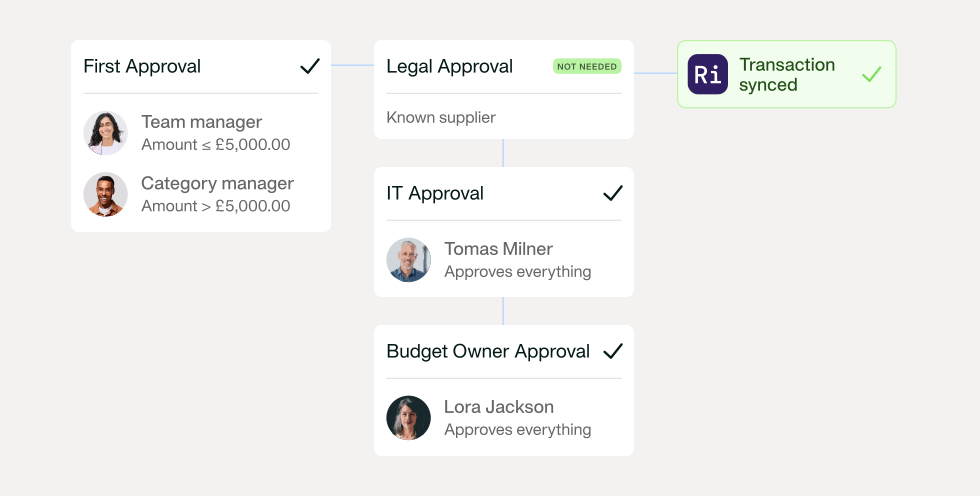
You can also configure approval workflows to treat incidentals differently from core travel spend, automatically approving anything within per diem thresholds, and escalating anything above them.
And 99.7% of transactions reconcile in your ERP with zero manual input through Payhawk. So now your finance team’s attention can shift from data entry and dispute resolution to forecasting, budgeting, and analysing spend.
Travel incidentals are an inevitable part of business travel. If your finance team can't capture, categorise, and reconcile incidentals without draining your travellers' time, automating that process is the next step.
A spend management platform built for modern business travel means real-time visibility, HMRC-aligned policy enforcement, and no incidentals falling through the gaps.
Book a demo to see how Payhawk helps finance teams take control of travel spend, from pre-trip booking to incidentals.
Zhenya is a creative content strategist specialising in crafting SEO-driven narratives across tech, SaaS, and B2B. At Payhawk, she blends storytelling, data, and product insight to create content that helps finance teams and drives measurable impact.