Why connect spend management to DualEntry
29 Sept 20269 min


Accounts payable software helps finance teams replace manual invoice processing, approval chasing, payment workflows, and reconciliation with structured, digital processes.
For growing finance teams, the benefits include faster invoice processing, fewer errors, lower manual costs, stronger controls, better cash flow visibility, cleaner audits, and more time for strategic finance work.

By submitting this form, you agree to receive emails about our products and services per our Privacy Policy.
AP automation is the process of replacing manual tasks across the invoice lifecycle with structured, digital workflows. That means automatically capturing invoice data, routing documents through approval workflows, syncing directly with your ERP or accounting system, scheduling payments, and maintaining a complete digital audit trail from receipt to reconciliation.
The business benefits include faster invoice processing, fewer data-entry errors, stronger internal controls, real-time visibility into liabilities, and more scalable finance operations.
For scaling businesses still managing accounts payable through shared inboxes and email chains, automation is a structural fix that ensures your next stage of growth is manageable.
This blog explores what AP automation delivers for modern finance teams, why manually managing AP can be risky, and how to evaluate a business solution to manage the process.
Scale smarter with powerful AI agent support

AP automation essentially handles the entire lifecycle of an invoice. From the minute it arrives to when it’s paid and reconciled.
AP automation supports:
Executed well, AP automation doesn’t just speed things up; it ensures the entire process is predictable, verifiable, and transparent.
Manual AP feels manageable until it doesn’t. When your invoice volume increases from 50 to over 100 each month suddenly you can’t keep track of who needs to be paid. When you receive your invoices by email, you might route them via a messaging thread and track them in spreadsheets. Already, this is very manually intensive as the volume grows. With so many steps, the margin for error or delay is high.
Manual AP often leads to:
The risks compound quickly. Outstanding invoices slip through the cracks of shared inboxes and manual processes, and month-end becomes a scramble to track down what’s been approved, making AP errors increasingly inevitable.
26% of UK finance teams spend more than five days per month processing invoices, and the average cost of manually processing a single invoice is around £11. The time and cost waste is bad enough, but manual processing also contributes to a significantly higher error rate.
The problem with manual: Manually processing invoices is time-consuming, from data entry and chasing approvals, to checking for errors and re-keying into your accounting system. All of these steps are individually carried out, and although seemingly insignificant alone, together they add up.
If your finance team is handling hundreds of invoices each month, just imagine the cumulative burden; it’s substantial.
How automation improves it: AP automation removes all the repetitive admin tasks from your finance team. Automated invoice processing capabilities capture invoice data digitally using OCR and structured data extraction. Approval workflows trigger without manual intervention. All approved invoices will sync to your ERP without re-entry. Finance team time is better spent on supporting business decisions and analysing spend.
The problem with manual: Manual invoice processing is expensive because every invoice requires time from finance, approvers, and sometimes procurement or operations. Costs can also increase through late fees, duplicate payments, missed discounts, and extra audit preparation.
How automation improves it: Accounts payable software reduces the manual effort behind invoice capture, coding, approval routing, payment scheduling, and ERP sync. That helps finance teams process more invoices without adding proportional headcount or relying on manual checks.
The problem with manual: When you’re keying in data manually, you’re opening your processes up to errors. And when things like wrong amounts, miscoded invoices, and duplicate submissions occur, it can cause delayed supplier payments and compliance risks, of course, but there is also significant time wasted correcting these errors.
How automation improves it: Automation significantly reduces errors at the source because OCR data extraction reduces manual keying. It also detects duplicate invoices matching existing entries, while three-way matching cross-references invoices against purchase orders and delivery notes before approval. Discrepancies are caught before they make it to payment.
This smoother process means your data is cleaner with a lower AP error rate, improving the quality of your financial reporting, accruals, and audit evidence.
The problem with manual: Let’s say your invoices sit in inboxes or they’re awaiting approvals that haven’t been chased yet, you’ve got a gap in liability visibility. Finance does not (or cannot) have an accurate picture of what the business owes.
How automation improves it: With automation, the liability visibility gap closes. Your finance team is able to see every invoice in the system, its approval status, due date, and payment schedule; all of it in real time. This visibility means better decision-making about payment timing, the ability to take advantage of early payment discounts where available from suppliers, plus avoid late fees and plan cash outflows with confidence.
The problem with manual: If you don’t have structured and automatically enforced approval controls, you could face huge financial losses as your business grows. It’s not just about eliminating intentional fraud, but payment errors made through informal workarounds or gaps in oversight.
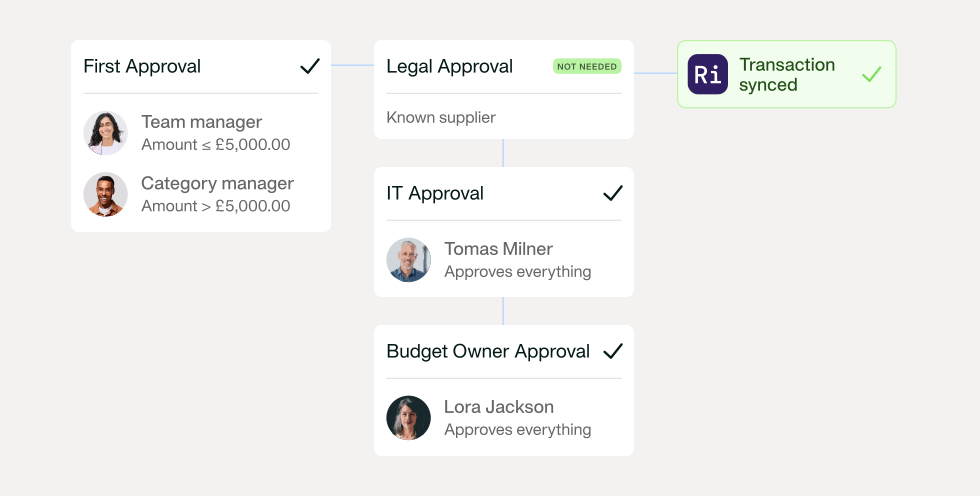
How automation improves it: AP automation introduces formal, structured processes. That means approval workflows are defined by your rules; you say who approves what, the value threshold, and what sequence, etc. Create role-based access controls to determine which members of staff can view, edit, or release payments. And with every action logged in a digital audit, employees are held accountable.
The problem with manual: The high-pressure manual AP close process drags on as finance teams rush to track records through email threads and estimate accruals.
How automation improves it: AP automation reduces the pressure on finance teams significantly. That’s because the system captures, codes, approves, and reconciles invoices automatically. There’s no need to reconstruct an approval chain or find missing documentation; it’s all there, timestamped, ready to trace.
And there are further benefits when it comes to external audits. Auditors can access searchable records instead of waiting for finance team members to manually compile evidence. This drastically shortens audit prep time.
The problem with manual: Paying vendors late can irreparably damage supplier relationships. You know that late invoice payments can mean uncertainty and strained cash flow for the vendor. All this can mean they no longer prioritise servicing your account, which could disrupt your supply chain.
How automation improves it: With AP automation, the payment process is more reliable and predictable. The system processes invoices faster because approvals happen within a pre-defined timeframe rather than whenever your approver gets around to it.
Consistency matters for any business that depends on strong supplier relationships. Better relationships look like favourable terms, maintaining priority service, and ensuring supply chain reliability as you scale.
The problem with manual: As you scale, you inevitably process more invoices, which means more work, eventually more headcount, and approval bottlenecks get worse as you add more suppliers, entities, or transaction volume increases. Suddenly, your processes don’t work as well as before.
How automation improves it: Your configured workflow can handle 100 invoices just as well as 2,000. The same workflow, same controls, audit trail, and approval structure. Scaling becomes more manageable because workflows remain consistent even as invoice volume, entities, and users increase. Multi-entity and multi-currency support help your processes scale regardless of geography. You can grow your financial operational capacity without a proportional increase in manual effort.
The problem with manual: If your AP processes are manual, your finance team is spending a lot of time correcting errors, doing data entry, and chasing approvals and documentation.
How automation improves it: By removing repetitive manual tasks, finance professionals can instead focus on work that adds value, like cash flow forecasting, budget management, vendor analysis, and supporting better decision-making with better data. Payhawk’s financial AI agent extends automation by handling repetitive operational tasks such as collecting invoices from vendor portals, chasing missing documents, and flagging anomalies.
Organisations want more from finance directors, more visibility, more control, and more accurate data. But to deliver this at scale, you can’t stick with manual processes. As the organisation scales, processes continue to become more complex, more entities, more suppliers, more users, the list continues.
You need a structured, reliable system to manage your AP processes, which means finding one with comprehensive, powerful AP automation capabilities.
You need a solution that supports your entire workflow. That means from receiving the invoice to payment and reconciliation.
If your team is spending its time on tedious, error-prone admin work instead of analysis and forecasting, your processes would benefit from AP automation. Payhawk’s solution ensures approvals, payments, controls, and visibility all work together seamlessly to improve efficiency and accuracy across your financial operations.
Explore Payhawk’s AP capabilities or book a demo to see them in action.
With over 15 years of experience in SaaS and digital communications, Paul specialises in translating complex financial concepts into clear, engaging narratives. At Payhawk, he combines creativity and analytical insight to help finance teams thrive through data-driven storytelling.