
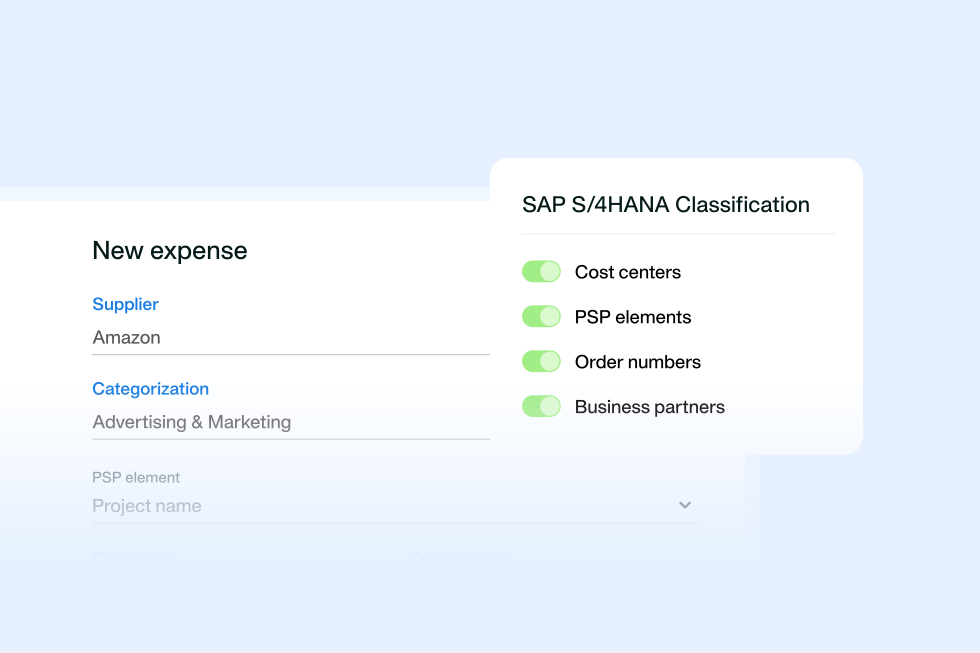
SAP S/4HANA procurement integration: what connects
13 Oct 202610 min


The future of procurement is not fully autonomous buying without human oversight. It is a more connected, AI-assisted workflow where routine checks, approval routing, policy enforcement, supplier data, and spend controls can be automated within clear rules.
This guide explains how AI and automation are changing procurement workflows, where agentic AI can add value, what companies need in place first, and how finance and procurement teams can stay in control as processes become more automated.

By submitting this form, you agree to receive emails about our products and services per our Privacy Policy.
By the time a CFO hears about "agentic AI in procurement," the real question is no longer what it is—it's whether it will actually reduce workload, enforce policy, and deliver measurable ROI without adding risk.
The bottom line: AI in procurement only creates value when it operates inside structured, connected processes—not alongside them.
Most procurement teams already have some automation. But workflows are often fragmented across tools, emails, and manual checks—slowing decisions, weakening control, and keeping finance teams reactive.
Agentic AI doesn't replace procurement processes. It executes them: validating requests against policy, routing approvals, flagging risks, and triggering next steps automatically. The prerequisite is that those workflows are clearly defined and connected. Finance needs orchestration, not just integration.
That distinction reframes the evaluation entirely. Instead of asking "Where can we use AI?", the better question is: Which parts of our procurement workflow are structured enough for AI to execute reliably?
AI is not the starting point. Workflow maturity is. Once procurement workflows are connected end-to-end, AI moves from experimentation to controlled execution at scale—with visible impact on speed, compliance, and cost.
The sections that follow break down what agentic AI in procurement actually means, where it fits, and which use cases deliver real operational value today.
Intake-to-pay done right — approve spend before it happens

To understand where agentic AI fits procurement, you need to separate three very different layers of technology that often get grouped together under "AI in procurement workflows."
Most systems today fall into the first two categories.
Traditional procurement automation follows predefined rules — reliable, but rigid. AI-assisted tools improve on this by surfacing insights and flagging risks, but still depend on someone to act on them. The workload shifts; it doesn't disappear.
Agentic AI introduces a third layer. These systems don't just identify problems — they resolve them. A purchase request that's out of policy gets blocked, not flagged. A renewal risk triggers a review workflow automatically. An approver is assigned and escalated based on rules, context, and timing — without waiting for someone to read a recommendation.
| Traditional Automation | AI-Assisted Tools | Agentic AI | |
|---|---|---|---|
| How it works | Follows predefined rules | Analyzes data, surfaces insights | Takes action within defined parameters |
| Example | Routes a request if it meets set criteria | Flags an unusual spend pattern | Blocks an out-of-policy request automatically |
| Human input needed | At setup; limited ongoing | To interpret and act on insights | For exceptions, edge cases, and governance |
| Adaptability | Rigid — only does what's configured | Moderate — improves with data | Higher — responds to context within rules |
| Output | Process completion | Recommendations | Executed workflow steps |
| Best for | Repetitive, stable processes | Visibility and decision support | End-to-end workflow execution |
This is why procurement workflows start to look different. The system moves from supporting decisions to executing them—within boundaries set by finance.
IBM captures this shift clearly, noting that AI agents can streamline procurement by automating supplier selection, contract management, and risk monitoring. The key point is not just automation, but continuous execution across multiple steps in the workflow.
That shift is already underway. 52% of organisations using GenAI now also leverage agents, and 39% have more than 10 running in production. Agentic AI in procurement is no longer emerging — it's becoming standard practise.
This creates a more precise way to evaluate AI: not whether it can generate insights, but whether your workflows are structured enough for it to act on them safely. Once that condition is met, agentic procurement becomes operational — enforcing policy, moving processes forward, and reducing manual intervention without removing control.
The value of procurement workflows becomes clear in execution, not theory. Procurement is a sequence of decisions, approvals, validations, and controls spanning request intake, vendor selection, contracting, purchasing, and payment. Most inefficiencies live in the gaps: manual checks, delayed approvals, missing context, inconsistent policy enforcement.
AI agents close those gaps—moving workflows forward automatically within defined rules, reducing friction without removing control.
Below are the use cases where that shift is already delivering value.
AI agents validate purchase requests against policy the moment they're submitted—checking categories, thresholds, and documentation, while verifying budget availability in real time. Once validated, requests are routed to the correct approver automatically. If approvals stall, the system escalates.
The result: faster approvals, fewer manual checks, tighter spend control before it happens.
AI agents continuously scan procurement data to detect duplicate vendors and overlapping services. When a new request comes in, the system surfaces approved vendors or existing contracts that already meet the need—along with historical pricing and contract terms.
This supports consistent vendor consolidation, one of the most direct levers for cost control.
Contracts are where procurement value leaks quietly. Terms are agreed once, then sit in a folder while renewal dates pass, price escalators trigger, and obligations go untracked.
AI changes what's possible here in four ways:
The agentic distinction matters here. An AI-assisted tool flags that a renewal is 30 days out. An agent opens the review, assigns it to the budget owner, attaches current spend against that vendor, and escalates if it stalls.
AI agents enforce procurement policies in real time. Out-of-policy requests are blocked or escalated instantly. Higher-risk transactions are routed through additional approval layers. Missing documentation is flagged before a transaction progresses.
Consistent enforcement across all activity—without added administrative burden.
Most spend analysis shows the data in retrospect: what was bought, by whom, at what cost. Useful for reporting, but is not useful for future decisions.
AI agents help group spend across categories, vendors, teams, and regions automatically, then use that baseline to project forward:
Again, the agentic layer is what turns a signal into an outcome. This is where procurement moves beyond execution and starts driving optimisation.
The PO features have given us a lot more visibility and control... It's now much easier to spot opportunities for cost-saving and find discounts that help the bottom line.
— Aventum Group
Across these use cases, the pattern is consistent. AI does not replace procurement decisions. It ensures that workflows move forward with the right checks, context, and timing—so teams spend less time managing processes and more time improving outcomes.
Agentic AI in procurement has two hard prerequisites: data that can be trusted, and governance that defines what the system is permitted to do. Without both, automation scales existing problems instead of solving them.
The fastest way to misunderstand agentic procurement is to assume it works independently of the systems around it.
It doesn't.
AI executes tasks inside procurement workflows, but depends entirely on the structure it operates within. Unclear workflows, inconsistent data, or disconnected systems don't get solved by AI—they get scaled by it.
This is why efficiency gains are uneven across companies. The technology is rarely the limiting factor. The operating model is.
Agentic AI relies on three foundations:
This isn't a limitation—it's a signal that AI performs best where workflows are already designed for consistency and control.
Equally important: what AI should not replace.
Supplier negotiation requires human judgement when trade-offs go beyond price. Strategic decisions—vendor selection across markets, long-term sourcing—depend on context that structured data alone can't capture. Stakeholder alignment across finance, operations, and leadership remains a human responsibility. And when edge cases fall outside defined rules, human intervention is still required to resolve them.
McKinsey reinforces this point, noting that the impact of agentic AI depends heavily on governance, data quality, and how well it is integrated into existing operating models.
The broader data supports this. Research from MIT found that 95% of enterprise GenAI pilots deliver no measurable P&L impact — not because the technology fails, but because most pilots never connect to the systems and workflows where value is actually created. Only the 5% that integrate AI into live, governed processes extract meaningful results. In procurement, that distinction is everything.
Autonomous agents operating across supplier data, contract terms, pricing decisions, and payment workflows create real exposure — and finance leaders should ask about these directly before deployment.
The risks are concrete:
The Hackett Group's research reflects this caution: 53% of procurement leaders cite unrealistic AI benefit expectations as a concern, with IP leakage and privacy risks ranking among the top barriers to adoption. These are not reasons to avoid agentic AI. They are reasons to evaluate it rigorously.
The non-negotiables before go-live:
These aren't optional additions. They're the foundation that makes autonomous execution safe enough to trust. For finance leaders, this reframes the role of AI.
It is not a replacement for procurement expertise. It is a multiplier of well-structured processes. When governance, data, and workflows are in place, AI scales execution. When they are not, it exposes the gaps. That distinction is what separates controlled automation from operational risk.
Adopting procurement automation AI is not about switching on a new capability. It's about preparing your procurement workflows so AI can operate with control.
This is where many initiatives stall — companies start with the technology, rather than the workflows it depends on. A more effective approach is phased and operational: readiness first, then execution.
Step 1: Map your current workflows
Not the ideal version — how requests, approvals, vendor selection, and payments actually move today. Where do delays happen? Where are decisions made manually? Where does information get lost between systems?
This step makes fragmentation visible. That visibility is essential before introducing AI.
Step 2: Identify the repetitive, rules-based tasks
These are the points where AI delivers immediate value — approval routing, policy checks, budget validation, and document matching. Predictable processes that AI can execute consistently. This is where automation typically starts.
Step 3: Centralise the underlying data
AI depends on structured, reliable information across spend, suppliers, approvals, and contracts. If that data is split across systems or managed manually, AI will be limited to isolated actions rather than end-to-end execution.
Step 4: Define thresholds, escalation paths, and approval logic
This is what allows AI to act safely. Clear rules determine when a request should be approved automatically, when it should be escalated, and when it should be blocked. Without this layer, AI cannot move from insight to execution.
Step 5: Introduce AI gradually
Start with low-risk workflows where outcomes are predictable and easy to validate. As confidence grows, expand into more complex areas. This phased rollout reduces risk while making impact visible early.
PwC highlights this clearly: successful adoption of agentic AI depends on governance, defined decision rights, and structured workflows that AI can operate within.
For finance leaders, the takeaway is simple. AI delivers more value when the processes around it are solid — not when you add more of it.
When those foundations are in place, AI doesn't just automate tasks. It executes procurement workflows with consistency, control, and measurable impact.
Agentic AI's impact is determined by the system it operates in, not the technology itself.
In many organisations, procurement isn't a single continuous workflow. Purchase requests sit in one tool, supplier data in another, invoices in a third, approvals in email, reporting pulled separately after the fact. In that environment, AI can support individual steps—but it can't execute across the full workflow. It lacks the context to validate decisions, enforce policy consistently, or move processes forward end to end.
This is why early AI initiatives often feel incremental. The technology works, but only within narrow boundaries.
The shift happens when procurement is part of a connected spend system.
When approvals, supplier workflows, invoices, and payments are linked, AI operates with full context. A purchase request becomes more than a request—it's tied to budget availability, supplier history, contract terms, and downstream payment flows. AI can validate, route, match, and trigger next steps without manual handoffs between systems.
Reporting changes too. Instead of reconstructing spend data after the fact, finance teams get a continuous, real-time view. Risks, anomalies, and savings opportunities surface as they happen.
This is where real value becomes visible: AI operating inside a connected platform where data, workflows, and controls are already aligned—allowing automation to scale without losing governance, and turning isolated efficiencies into measurable improvements in speed, visibility, and cost control.
Architecture matters more than features. When procurement, payments, and spend data are connected, AI executes with confidence. When they're not, impact stays limited regardless of how advanced the technology appears.
Explore procure to pay software or see how procure to pay automation works in practise.
The value of AI in procurement shows up in how quickly teams operate, how consistently policies are enforced, and how clearly spend is controlled as the business scales.
The shift is measurable. Industry data points to 30–50% reductions in procurement cycle times as AI takes over execution-heavy tasks. Around 20% of procurement roles are expected to be transformed by 2030—repositioned toward supplier relationships, strategy, and AI oversight. Among companies already running agentic AI in production, 88% report measurable ROI versus 74% of broader GenAI adopters. The gap reflects the core argument: agentic AI delivers more because it executes rather than just advises.
This is especially critical for mid-market and growing companies, where complexity increases faster than headcount.
Now, every expense flows seamlessly into NetSuite in real time. No more chasing receipts, no more delays… We've freed up weeks of work for our team, and we have complete finance visibility to support our decisions. — Aventum Group
Across these outcomes, the pattern is consistent: AI in procurement makes processes faster, more predictable, and easier to scale—without adding complexity for the teams managing them.
Agentic AI can add real value to procurement workflows—but only under the right conditions.
It works when procurement processes are clearly defined. When spend data is structured and reliable. When approvals, suppliers, invoices, and payments are connected across finance. And when governance is strong enough to let AI act within clear boundaries.
Without that foundation, AI remains limited to insights. With it, AI executes.
That is the shift.
For finance leaders, the implication is straightforward. AI is not the starting point. Workflow maturity is. The companies seeing the strongest results are not the ones adopting AI fastest, but the ones building procurement workflows that AI can operate within—safely, consistently, and at scale.
Looking ahead, the trajectory is clear. Operational impacts from agentic AI are already arriving within 12 to 18 months for many procurement use cases, while deeper strategic transformation — changes to operating models, team structures, and sourcing strategy — will play out over three to five years. What is coming next is not just faster automation. It is procurement that learns, adapts, and acts continuously: agents that manage supplier risk in real time, flag contract leakage before it happens, and support negotiation decisions with live market data. The procurement function does not disappear in this future — it shifts. Finance and procurement professionals move from executing transactions to governing the systems that execute them.
If you are exploring AI in procurement, the next step is not adding another tool. It is making sure your workflows, approvals, and spend data are connected enough for AI to deliver meaningful impact.
If you want to learn more about financial ai agents and the procurement ai agent to see how this applies to your own workflows, you can also book a demo.
With over 15 years of experience in SaaS and digital communications, Paul specialises in translating complex financial concepts into clear, engaging narratives. At Payhawk, he combines creativity and analytical insight to help finance teams thrive through data-driven storytelling.

