Why connect spend management to DualEntry
29 Sept 20269 min


Logistics procurement becomes harder when thousands of purchases happen across drivers, depots, suppliers, and finance teams. Learn how AI, spend controls, approval workflows, and real-time visibility help logistics companies control spend at scale.

By submitting this form, you agree to receive emails about our products and services per our Privacy Policy.
Logistics procurement becomes harder when thousands of purchases happen across drivers, depots, suppliers, and finance teams. Learn how AI, spend controls, approval workflows, and real-time visibility help logistics companies control spend at scale.
In logistics, all the small purchases, like a driver paying border fees, a dispatcher approving an emergency repair, or a depot manager buying consumables, seem relatively insignificant costs. But, at scale, they become almost impossible to control.
For your finance team, keeping a grip on the day-to-day spend that keeps trucks moving is far more challenging than negotiating lanes or managing contracts. Because operational spend happens away from the finance team, often in small increments and largely ad hoc, it becomes much harder to control. That increases the risk of wrong approvals, funds being used for the wrong purpose, missing receipts, and lengthy reconciliation processes.
Here, we’re looking at logistics procurement from a financial control angle. We discuss why spend becomes complex at scale, the difference between freight sourcing and operational purchasing, and how AI in procurement helps finance teams improve spend visibility and tighten spend control both before and after money leaves the business.
Streamline logistics procurement workflows

Logistics procurement is the process of sourcing, approving, buying, paying for, and tracking the goods and services a logistics business needs to operate.It covers everything from strategic carrier contracts to the everyday operational purchases required to keep vehicles, drivers, and depots running smoothly.
But the term carries two meanings, and they constantly get blurred in search results. Splitting them apart makes procurement in logistics easier to manage:
| Type | Meaning | Examples |
|---|---|---|
| Strategic logistics procurement | Sourcing transport, warehousing, carrier capacity, lanes, contracts, and supplier relationships | Freight contracts, carrier selection warehouse services |
| Operational logistics procurement | Controlling day-to-day purchases needed to keep the business moving | Driver expenses, fuel, tolls, parking, repairs, oils, consumables, emergency funds, supplier invoices |
Strategic procurement is a sourcing problem. Operational procurement is a control problem, and it’s the one that scales painfully. This blog focuses on the second: operational logistics procurement and the logistics expense management challenges that come with it.
The more trucks, drivers, and routes you add, the higher the volume of operational expenses, making it harder for finance to control.
Discordia, one of Europe’s largest road hauliers, operates more than 1,500 trucks and 2,000 drivers; its finance processes had to support high-volume driver payments and reporting without grinding to a halt. That scale exposes problems that smaller operators can paper over. Several issues compound at once:
Purchases happen away from the finance team
Drivers, dispatchers, depot teams, and local managers often need to spend while operations are already in motion. Finance is not in the room.
Approvals happen with incomplete context
A manager may approve a request without knowing the budget impact, the supplier, the category, or the policy risk. The approval looks fine; the information behind it is thin.
Approved funds can be spent on something else
This is the quiet one. Finance needs controls that check not just whether money was approved, but how someone spent it.
Receipts arrive late or go missing
Missing receipts make reconciliation, VAT reclaim, and month-end close slower and messier.
Emergency purchases are common
Border delays, breakdowns, extra stops, and unexpected driver needs all create urgent spend that cannot wait for a Monday approval meeting.
Traditional bank cards offer limited control
Finance often cannot see the spend until the money is already gone, which makes employee spend management reactive rather than preventive. This challenge isn't unique to logistics.
Deloitte's 2025 Global Chief Procurement Officer Survey found that procurement leaders are increasing investment in digital procurement and AI to improve visibility, efficiency, and control in increasingly complex operating environments. As logistics businesses scale across drivers, depots, suppliers, and countries, the need for real-time visibility becomes even more critical.
Data lives across too many systems
Cards, invoices, receipts, budgets, ERP records, and approval chains sit in separate places, so building a single picture of spend takes manual effort. The result is reduced spend visibility and more room for maverick spend to slip through.
Control driver, fleet, and supplier spend with AI

You’d assume an approved purchase was a controlled one, which is not necessarily true.
The problem at Discordia was not only manual admin. The bigger control risk was that some requests were approved incorrectly in the first place. In other cases, funds approved for one purpose could be spent on something else entirely. Those two problems aren’t significant singularly, but when you multiply them across thousands of drivers, you get margin leakage, weak accountability, and a steady stream of manual investigation work that finance hasn’t planned for.
Controlling spend means being able to answer six questions for any transaction, not just the first one:
| Control question | Why it matters |
|---|---|
| Who requested the spend? | Confirms ownership and accountability |
| Who approved it? | Confirms policy and budget responsibility |
| What was it approved for? | Defines the expected purpose |
| Where was the money actually spend? | Detects misuse or incorrect merchants |
| Was a receipt or invoice captured? | Supports reconciliation and audit trail |
| Did the transaction match policy? | Prevents out-of-policy spend |
Approval answers the second question, whereas spend control software answers all six. The gap between the two is where the risk lives.
AI handles repeatable admin, so finance can focus on the exceptions; it’s as simple as that. Here’s where AI procurement software earns its place.
Employees should not need to understand every finance policy before they can make a request. A driver knows what they need and why; they should not have to know the cost centre code. AI can guide them to provide the supplier, amount, reason, cost centre, budget, and supporting details through a simple conversation. Payhawk lets employees start purchase requests in plain language, while AI-enabled workflows apply controls and route requests correctly behind the scenes.
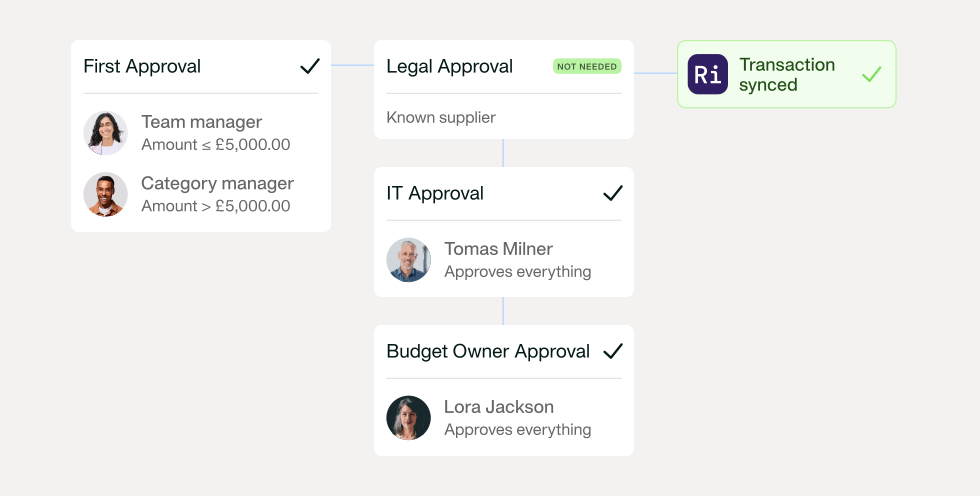
Approval routing should reflect how the business actually works. That means routing based on amount, role, entity, country, merchant, category, project, or budget; not a single generic chain that sends everything to one overworked manager.
Logistics teams need fast approvals because operations don’t pause. Finance still needs real-time budget impacts and policy checks. AI lets you have both, applying the rules at the moment of request rather than discovering a breach weeks later.
Before Payhawk, Discordia’s drivers collected paper documents and carried them back to the office. With Payhawk, drivers scan receipts in the mobile app, and the system processes them automatically, which removes a huge amount of manual handling and lost paperwork.
AI should not move finance teams from one admin queue to another. Instead, it should reduce repetitive work so finance can spend more time shaping strategy, understanding business needs, partnering with operations, and supporting growth, while still maintaining strong controls. This is the core idea behind Payhawk’s procurement AI agent, and the early numbers from Discordia are telling.
A good workflow isn’t complicated. It’s a clear sequence where each step closes a gap the previous one left open. This is procurement automation applied to the realities of a transport business.
A driver, dispatcher, or operations employee submits a request before the spend happens, not after.
Submitting first is what makes everything downstream possible; you cannot control money you only hear about later. Example: a driver needs extra funds for border fees, tolls, or an emergency repair.
AI gathers the information available from the requester and highlights any missing details so procurement, operations leaders, or finance teams can complete the process before approval.
Rather than the driver sending a dispatcher a vague text message, the request comes through a structured flow that captures the reason and expected cost up front. Example: instead of “need money for the truck,” the request specifies the repair, the garage, and the amount.
The workflow checks whether the request fits company rules before you can release any money.
This is where out-of-policy spend gets caught early. Example: a fuel request may be allowed automatically, but a non-approved merchant or an unusual region may trigger an extra approval.
Approval routing should match the company’s operational structure, not a one-size-fits-all chain.
Different spend should reach different people. Example: route-level spend may go to a fleet manager, while supplier invoices go to finance or procurement.
Once approved, controls should limit how the money can actually be used.
Approval and enforcement are separate things; this step makes them connect. Example: the approval amount is made available through a card or controlled payment method, with merchant, category, or amount rules attached.
Employees capture receipts in the app, and invoices flow into the AP workflow. If you pay online, the Agent Fetch, a capability of Payhawk’s Financial Controller Agent, even gets the receipt for you.
This is where reconciliation is won or lost. Example: Baton’s drivers previously brought receipts back to the office after several weeks, and with many lost along the way; automated capture removes that risk.
The finished workflow gives finance full visibility without forcing a manual check on every purchase. Finance reviews what looks wrong and trusts the controls for everything else.
Operational spend in logistics is varied and constant. There are plenty of examples where card controls and workflows help the transport and logistics industry:
Driver spend
Fleet operations
Depot and supplier spend
Each of these can be small, but together, across thousands of drivers, they’re the bulk of operational logistics expense management.
Discordia is the clearest example of control at scale. With more than 1,500 trucks and 2,000 drivers, and a second trial involving 700 drivers, the company needed spend control that didn’t depend on people being near a desk. Drivers can request emergency transfers via the app and with approval in seconds. They scan receipts with their phones, and Discordia expected 90% of receipts to be processed automatically. The scale only grows from here; the company is targeting around 7,000 vehicles by 2030.
Discordia's challenge wasn't simply processing expenses faster. The company needed a way to ensure approved funds were used for the intended purpose while maintaining visibility across thousands of drivers.
As Discordia's CFO put it:
We've boosted employee productivity by over four times. Payhawk's automation has significantly cut processing time and reduced the errors that came with manual expense handling.
You can read the full story on how Discordia is transforming the transport industry with fintech and the wider Discordia story.
Baton's drivers previously used traditional bank cards, while the accounting team lacked direct visibility over expenses as they happened. Drivers had to call dispatchers when they needed funds for oils and consumables, adding friction and delay.
The change was visibility in the moment. As Baton describes it:
In real time, you can see who spent what and with which merchant, even before the expense document is uploaded.
That is the difference between reacting to spend and controlling it.
Read the full Baton story.
Starship shows the efficiency side of the same coin. By connecting cards, receipts, and reconciliation, the company achieved a 40% reduction in the cost to process payments, a 30% reduction in the cost to process reimbursements, and a 25% reduction in the cost to process card transactions, while eliminating reconciliation issues.
Read the full Starship story.
A few things separate teams that control operational spend from teams that chase it:
The value of controlled logistics procurement looks different depending on where you sit.
For CFOs, the gains are scalability, control, and margin protection: stronger governance across distributed teams, less operational drag on finance leadership, better spend visibility before month-end, and procurement processes that scale with the fleet.
For finance directors and heads of finance, the focus is on reporting and lean processes: faster month-end, better budget versus actual visibility, cleaner finance data, and less dependence on manual follow-up.
For financial controllers, fewer missing receipts and less manual matching mean more than efficiency. They help unblock controllers from repetitive admin, giving them more time to grow in their role, focus on higher-value finance work, and contribute more strategically to the business.
For procurement leaders, it’s policy and purchasing efficiency: controlled purchase requests, more consistent approvals, reduced maverick spend, and a clearer view of committed versus actual spend.
For AP managers, it’s invoice and payment workflows: faster invoice approval, fewer disconnected supplier payments, more complete documentation, and a lighter manual processing load.
Across all of these, procure-to-pay automation is what ties the picture together.
Keeping control of thousands of operational purchases increases risk. Risk of wrong approvals, spend misuse, missing receipts, and delayed reconciliation quietly create margin leakage and compliance exposure, and it’s not easy to spot.
AI helps you control these operational purchases by capturing requests in plain language, routing approvals to the right person, enforcing policy and budget before money moves, and surfacing the exceptions that actually require human intervention.
Payhawk connects the full chain; purchase requests, approvals, cards, receipts, invoices, payments, budgets, and ERP data sit together rather than scattered across systems.
If your logistics team is scaling, explore how Payhawk's procurement AI agent can help you control spend from request to reconciliation. Book a demo to see what this could look like for your team.
With extensive experience in finance, marketing, and digital strategy, Raphael combines quantitative insights with compelling storytelling to drive regional marketing success and customer-focused innovation in financial SaaS solutions.