Why connect spend management to DualEntry
29 Sept 20269 min


2025 created countless AI headlines. But in finance, what matters is what actually holds up in the real world. At Payhawk, our focus has been simple: build AI that helps companies manage money intelligently, so they can realise their full potential. See what that looks like in practice and what it means for 2026.

By submitting this form, you agree to receive emails about our products and services per our Privacy Policy.
A lot was said about AI in 2025. Most of it was noise.
In finance, noise is expensive. We deal with cash and controls, and trust is the job. So, at Payhawk, we didn’t rush to bolt “AI” onto workflows that weren’t ready.
Instead, we focused on one standard: AI should do real work safely and within the controls finance teams already run.
That is what “Smart money just got smarter” means at Payhawk. It’s about using AI to help money move faster through a business in 2026, without loosening control.
In 2025, we launched two AI-native products, Travel and Procurement, and they crossed $1M in sales in the first 33 days (while it took us 33 months to reach that milestone with our first product).
We also upgraded our Global Payment Account, expanding payment coverage across 120 countries, significantly improving FX, and adding safeguards for customer funds with JP Morgan.
Orchestrate finance with ease & efficiency: Meet the agents

Spend management started with smart cards and proactive controls, proving you can govern spend before it happens, not just review it after.
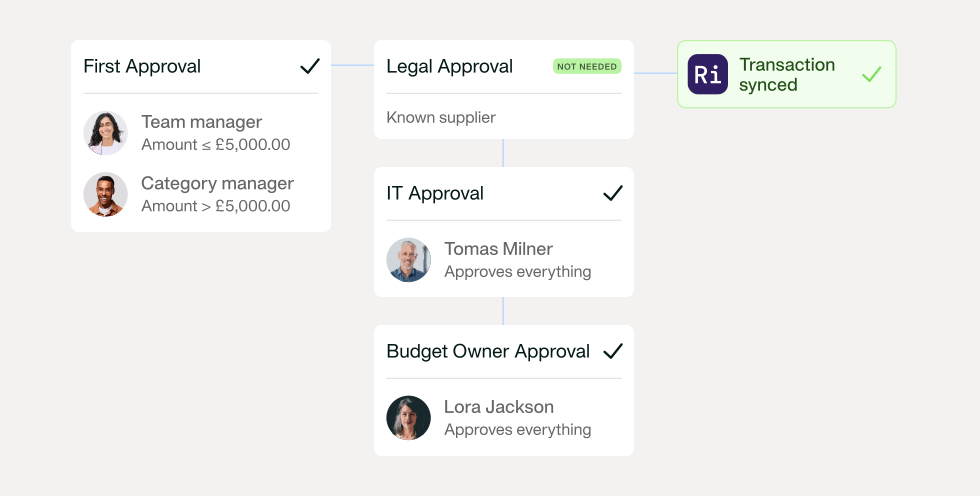
Traditional banks don’t solve this because their responsibility ends when the payment goes through and the money settles. But for a business, the hard part is the work around the payment: The request, budget check, and approval before it, and the receipts, coding, reconciliation, and audit after it.
That’s why managing money still drags businesses down. The work is slow and manual, scattered across too many handoffs. Too often, finance ends up chasing exceptions and stitching the story together after the fact, instead of steering the business in real time.
The category is expanding toward total control, simplification, and automation of how money moves end-to-end. From request to approval to payment to accounting, across bills, cards, expenses, travel, and procurement.
AI has the potential to change the experience, but only if it’s built on the hard foundations finance needs. In this domain, the hard part has never been the interface.
It’s permissions, approvals, audit trails, ERP depth, and payments execution. “AI-native” in finance doesn’t mean starting from scratch. It means making that foundation feel effortless for employees, while staying strict for finance.
That’s the shift we put into our Winter ‘25 Release. Spend becomes a conversation, but control stays tight.
At the platform level, the direction is simple:
The best signal of progress is what customers do in the product, and how much of their spend they run through Payhawk. Three things stand out:
1) More total spend, and it’s not just cards
In 2025, Payhawk reached $3.2B in annual Total Payment Volume (TPV), up 96% year on year, demonstrating strong product adoption growth.
It’s a mix of card and bank payments where the high-control work lives: bills, suppliers, approvals, and payment execution.
The introduction of our Global Payments, with exceptional FX rates supporting 120+ currencies, gave a major boost to our international payments coverage. This was one of our most requested features, so customers can pay suppliers for a fraction of the cost a bank would charge, with FX rates better than Revolut and Wise, and Swift payments at roughly a quarter of the cost of major banks in Europe.
Furthermore, we introduced Global Payments without relying on additional partners like Wise that require additional KYC and create a disconnected experience for customers.
,%202021%20-%202025%20($%20m)-1.avif)
2) More mid-market and enterprise adoption
Mid-market and enterprise teams buy spend software to enforce policy across entities, teams, and systems and to stand up to audit scrutiny.
Combined Mid-Market and Enterprise now represent 48% of our customers, up from 22.0% in 2021. This has been a key growth driver for us over the years, and it’s a strong signal that the category is moving up-market. It also reflects the maturity of our software stack, which can now serve customers with thousands of employees across multiple countries.
,%202021-2025%20(2).avif)
3) Used across markets, not as a local add-on
Today, over 5,000 businesses in 32 countries use Payhawk to run spend with a consistent control model across entities and geographies.
Put simply, customers are using Payhawk for greater spend across more workflows in more complex environments.
We don’t just ship AI. We want to run Payhawk differently because of it.
That’s why we hired a Chief Efficiency Officer and built a dedicated team focused on rethinking high-impact processes end to end, starting with areas like outbound sales execution and compliance-driven onboarding. He’s an ex-founder and CTO who’s built and scaled a business and raised $180M from investors like Index and Insight, and he’s now leading an engineering team using AI to redesign how key departments work.
The goal isn’t “AI adoption.” It’s measurable business performance: faster pipeline creation, faster onboarding, less busywork, and higher quality. We want Payhawk to be one of the few examples of a “traditional” fintech company that can operate with the speed and execution of an AI-native SaaS startup.
The principle is the same as in the product: don’t automate a few steps and call it transformation. Redesign the workflow end-to-end, let AI handle the repetitive work, keep strong quality guardrails, and measure the impact on speed and outcomes.
We’re not building AI for demos or webinars. We’re building AI that reduces workload, increases compliance, and stands up to audit.
We started where the pain is real and “better automation” doesn’t solve it, especially in business travel and procurement. AI lets us change the experience and the economics, not just speed up the same workflow.
In 2026, our bar stays the same:
That’s the operating model behind our 2026 focus.
If you’re a customer, thank you for pushing us to earn trust with what we ship, not what we claim!
If you’re evaluating spend management in 2026, ask this: Does the platform just help you pay and track, or does it remove friction from how money moves (from request to approval to payment to accounting), with control built in and world-class FXs and payments infrastructure behind it?
That’s the standard we’re building to.
Hristo is the compass guiding Payhawk's journey. With a rich background in engineering аnd product management he is a stalwart advocate for our products and customers, bringing a mix of innovation and user-centricity to everything we do. Outside the office, you'll catch him enjoying camper and sailing trips, shredding slopes on his snowboard, or simply soaking up precious moments with his family.