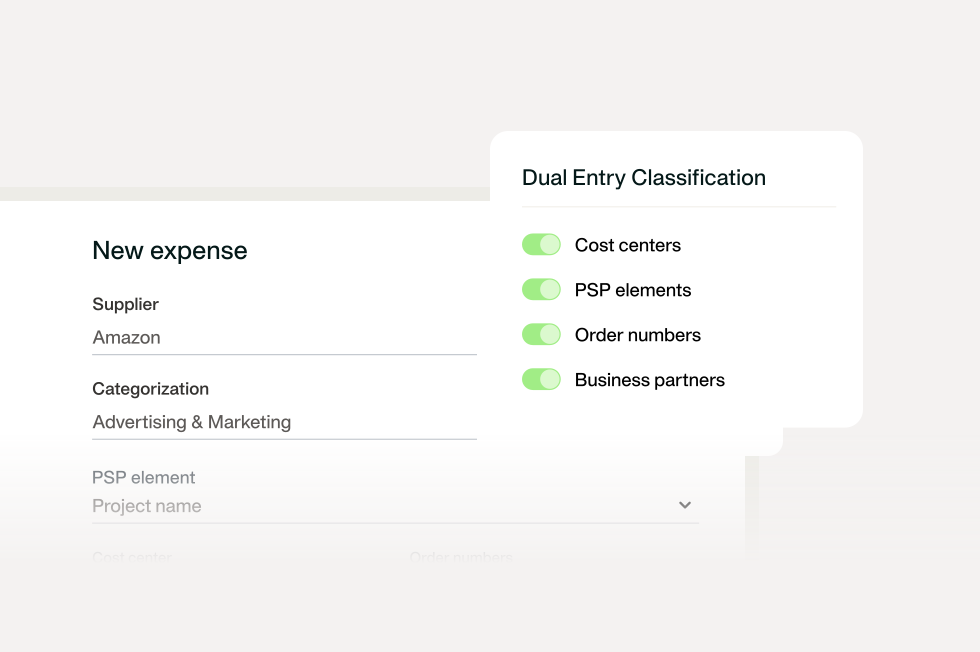
Why connect spend management to DualEntry
29 Sept 20269 min


Traditional and AI-native ERP vendors are converging on the same pitch: faster onboarding, better UX, and intelligent automation. The real question finance teams should be asking isn't whose ERP is newer - it's how much of the ledger they're willing to automate, and whether they can still explain what the AI did and why.

By submitting this form, you agree to receive emails about our products and services per our Privacy Policy.
If you are a CFO or financial controller looking at ERP options right now, the pitch decks are starting to sound alike. Traditional vendors say they have rebuilt their platforms for AI. AI-native startups say they were born for it. Everyone claims faster onboarding, better UX, and intelligent automation.
Underneath the noise sits a question that finance teams ask and vendors rarely answer directly: how much of the ledger are you willing to hand over, how much of the spend orchestration in front of it are you willing to automate, and what do you get to see afterwards?
I spent a week in San Francisco meeting teams from the new generation of AI-native ERP platforms - Rillet, Dual Entry, Campfire, and three others still in stealth - to understand how they frame the opportunity in front of them. Payhawk is not picking sides. We integrate with ERPs across the spectrum, and finance leaders and implementation partners alike are asking us what we make of it.
The claim: AI-native ERPs argue that systems built in the 1990s and early 2000s weren't designed for machine learning. Their data models are rigid. Their APIs were added later. Retrofitting AI onto those foundations is harder than building AI into the transaction engine from the start.
My observation: Older systems do carry technical debt, but rigidity and debt are not the same thing. A fixed data model and a prescribed process are how those platforms have held controls steady across tens of thousands of customers and 40+ jurisdictions - it is why auditors are comfortable with them and why a controller can predict what the system will do. What the new entrants read as inflexibility is, from the finance seat, often the reason the number can be trusted. That said, Oracle, SAP, Microsoft and Sage have invested billions into cloud re-platforming and AI feature development. Their embedded AI tools - SAP's Joule, Microsoft's Copilot, Sage Copilot, NetSuite's AI features - are live now, with agent capabilities arriving in staggered releases rather than all at once. The gap between "AI-native" and "AI-enabled" is narrowing, and faster than the marketing on either side suggests.
Where it gets tested: The architecture debate resolves itself the moment a real month's data goes through the system. Two hundred invoices, twelve vendors, three currencies, varying approval hierarchies - that is the workload that separates a product tour from a workflow. Whether the model learns from corrections, and how it behaves at the edges, tends to become obvious quickly and is difficult to establish from a demo.
The claim: AI-native ERPs point to traditional implementations taking six to twelve months, requiring expensive consultants, and holding up workflows in the meantime. The new platforms promise onboarding in weeks because they ship with pre-configured workflows instead of blank-slate flexibility.
My observation: This is a fit question, not a quality question. Speed versus customisation is a real trade-off. If your client has straightforward needs - one entity, one currency, standard expense categories - then a pre-configured system might be perfect. But if they operate across multiple jurisdictions, have complex approval hierarchies, or need custom reporting for investors, they'll hit the limits of "opinionated software" quickly.
Where it gets tested: Reference customers are the only reliable signal here, and only if they match on complexity rather than on logo. A 30-person single-entity company and a 300-person company with subsidiaries in four countries are not running the same implementation, and a testimonial from the first says very little about the second.
Faster implementation also changes what finance teams need from their advisors. Where a rollout once consumed six months of configuration work, the value moves upstream - into system selection, process design before the software goes in, integration architecture across the finance stack, controls and data governance, and the longer-term transformation plan. The implementation partners we work with are already making that shift. It is worth knowing which kind of engagement you are buying.
The claim: Most of the traditional ERP interfaces feel like they belong to a larger company - designed for the complexity a business grows into. The AI-native platforms have modern interfaces - clean dashboards, mobile-first design, intuitive navigation.
My observation: UX matters, but a refreshed interface is the smallest version of the opportunity. The incumbents are shipping UI updates quickly, so a visual gap closes faster than a capability gap.
The more interesting shift is that intake itself can now be intelligent. The question is no longer how many clicks it takes to submit an expense, but whether the submission needs to happen at all - whether the system can capture, code and route the transaction on the employee's behalf and only surface what genuinely needs a decision. That is the difference between a prettier form and work leaving the finance team's queue.
This is territory we already operate in. A Payhawk user can raise a request from their phone on the way to a meeting and have it coded, routed and approved without opening a desktop. The interface is almost beside the point; what matters is how little of the process the person has to carry.
Where it gets tested: In the trial, and specifically with the people who will live in the system daily rather than the person who signs for it. Training burden, whether routine tasks are findable without a manual, and whether approvals genuinely work on mobile are the details that decide adoption - and none of them show up in a demo run by the vendor.
UX remains a tiebreaker rather than a primary selection criterion. But for lean finance teams without the capacity for multi-week training programmes, the tiebreaker carries more weight than it used to.
The claim: In AI-native ERPs, the machine learning model was trained on the database schema from the beginning. It "understands" transactions at a structural level. In traditional ERPs, AI is added as a copilot feature on top of existing workflows.
My observation: Both approaches can deliver useful automation if implemented well. The question isn't "is the AI native or bolted on?" The question is "does it reduce manual work in ways my client's team will actually notice?"
Where it gets tested: In the mess. A hundred real expenses with inconsistent descriptions, mixed currencies and partial receipts will separate the two architectures faster than any technical explanation. The numbers that matter are the share handled without intervention, the accuracy on the remainder, and whether exceptions are surfaced clearly or simply left in a queue for someone to find.
The claim: Fewer manual touchpoints means fewer hours, and fewer hours means the licence pays for itself.
My observation: AI capacity is metered. Consumption-based pricing on agentic features means a workflow that looked free in the demo has a per-line cost in production. An assistant that reads purchase orders out of an inbox can cost more per line than the purchase order module it is replacing, and the bill scales with volume rather than with headcount. Savings in one part of the stack can quietly reappear as spend in another.
Worth modelling at your own transaction volume rather than the vendor's example volume, and worth asking which capabilities are bundled into the licence and which are metered.
Everything above is a features conversation. This one is not, and it is the reason several of these evaluations stall.
The unspoken fear behind AI in the ledger is that automating it means losing sight of it - that "AI-native" quietly becomes "AI-opaque", with entries appearing and reconciliations clearing without anyone able to explain why. That fear is rational. A controller cannot sign off on a number they cannot trace, and an auditor will not accept "the model decided" as a control.
The credible players in this space appear to understand that this, rather than speed or interface, is the real gating issue. The line they draw is between AI drafting and AI posting: the model proposes a journal entry, a match or an accrual, but posting happens only through a validated, rule-checked path with a human approval gate - and the rationale behind the proposal is preserved alongside the eventual sign-off. Where that line is drawn clearly, finance teams get comfortable quickly. Where it is blurred, they do not.
There is also a straightforward incumbency argument that no pitch deck addresses. Finance functions are risk-managing functions, and nobody has been dismissed for selecting the established vendor. That is not conservatism for its own sake: the vendor holding your general ledger needs to still exist, still be certified, and still be supported in five years. An unproven platform can be seen to carry a category of risk that has nothing to do with the quality of its software.
Which suggests the real prize is not AI that works invisibly. It is AI that works legibly — fast enough to justify the switch, but transparent enough that a controller or auditor can reconstruct not just what changed, but what the system proposed, on what logic, and who approved it.
That is the same tension that surfaced around onboarding speed and slick interfaces. Pre-configured, opinionated software is attractive precisely because it removes friction. Removing too much friction is exactly what erodes the confidence a finance team needs to actually rely on it. The platforms that win this niche may be the ones that treat visibility as a feature to design for, rather than a compliance box to tick afterwards.
Here's what none of these AI-native pitch decks mention:
The ERP may not be your bottleneck.
The bottleneck is most often getting clean, accurate data into the ERP in the first place.
For example, when managing business spend, you can run the most advanced, AI-native, beautifully designed ERP available, but if the finance team is still:
...then the ERP is a very good ledger receiving late, incomplete data. It is not orchestrating anything.
Two failure modes matter more than they get credit for. The first is latency: a card feed that posts on a delay does not just inconvenience the cardholder, it moves the start of month-end close. The second is fragmentation: when spend originates in three systems and lands in a fourth, the question of which one is the source of truth is answered informally, in spreadsheets, by whoever is closing the books. Neither problem is solved by the ERP being newer.
This is why the "traditional vs AI-native" debate misses the point for most mid-market finance teams.
The real question is: does the broader finance stack make the ERP useful without making the team miserable?
And that comes down to integration, automation, and workflow orchestration before data hits the ERP.
One platform that keeps your ERP data clean

Whichever direction you lean, three questions tend to surface the difference between a system that will hold up and one that will not.
Don't just ask "does it integrate with our card provider?" Ask how the integration works. Is it real-time or batch? Does it require middleware? Who maintains it when the API changes? If your card provider releases a new transaction format, will the integration break?
This is where depth of integration matters. A "certified integration" that requires manual CSV uploads every week is not an integration - it's a workaround with a badge.
Every ERP - traditional or AI-native - will encounter edge cases. The question is: does it surface them intelligently, or does it fail silently and create a reconciliation nightmare three weeks later?
Ask for a reference customer to walk you through their actual close process. Not the demo version. The real version. How many manual steps? How many spreadsheets? How long from transaction cutoff to final reports?
This is where the rubber meets the road.
The established vendors have customer bases in the tens of thousands. They have partner ecosystems - thousands of consultants and integrators who know the platform inside out. They have compliance certifications across 40+ jurisdictions. They have integrations with every payroll provider, AP automation tool, and banking platform you've heard of.
The new entrants don't have that yet, but are developing it. And the question they will have to find an answer to is: will they scale into complex, multi-entity, multi-currency environments without losing the simplicity that makes them attractive today?
Join Payhawk’s partner program today
In a market defined by rapid disruption, the challenge for any business is to separate architectural hype from operational reality. The decision to move between a legacy incumbent and an AI-native newcomer isn't just a technology choice; it is a strategic bet on how your finance function will scale.
Cutting through the marketing noise requires returning to the first principles of your business operations. Regardless of the vendor's pitch, successful navigation of this shift depends on answering several fundamental questions:
That last point deserves particular weight. Automation that cannot be explained after the fact is not a control; it is a liability waiting to surface at the worst possible moment - during an audit, a board review, or a raise.
The disruption in the ERP market is real, but its value is only realised when the chosen platform protects the company's reputation, ensures data integrity, and supports a sustainable growth trajectory. Focus on these fundamentals and the architectural debates become secondary to business outcomes.
We do not have a horse in the traditional-versus-AI-native race. We integrate with the leading ERP systems in the US and Europe, and we are in conversation with the AI-native platforms about building integrations as they scale.
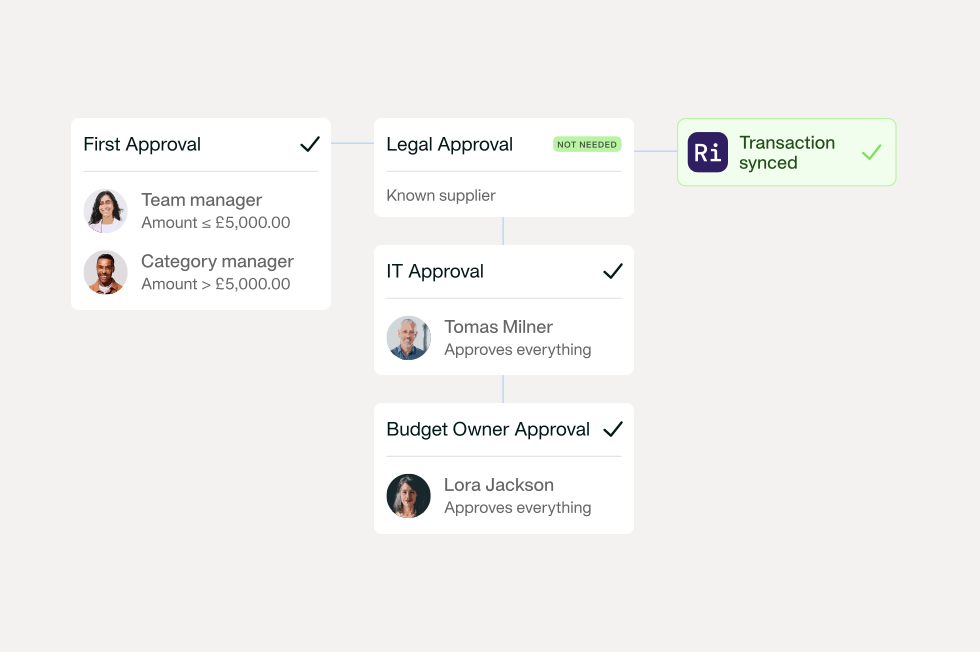
Our job is to make sure that when someone on your team swipes a corporate card, books a flight or submits an invoice, that transaction reaches your ERP automatically - categorised correctly, with the right approvals, on the right cost centre, in real time, with the trail of how it got there intact.
Whichever ERP you choose, the spend layer in front of it stays the same. That is deliberate. It means the ERP decision does not have to carry the weight of also being a workflow decision.
Whether their ERP is 25 years old or 25 days old.
Because here's what we've learned from working with implementation partners across Europe and North America: the ERP is your system of record. But the workflows around it - capturing expenses, routing approvals, syncing transactions - those determine whether the finance team spends their time on strategy or data entry.
That's the orchestration layer. That's where you add the most value. And that's where the AI-native vs traditional debate becomes less important than the integration depth, workflow automation, and data quality you architect around the ERP.
Make month-end a review, not a rescue

The ERP market is entering a more dynamic phase. AI-native platforms are challenging assumptions about implementation speed, finance UX, and automation. Established ERP vendors are responding with major AI investments of their own.
For implementation partners, the next 12–18 months will clarify:
None of these questions have to be answered alone. Payhawk works with a broad network of implementation partners, accountants, and finance transformation specialists - the people who know these systems in practice, not just on paper. Whatever stage you're at, we can connect you with the right expertise and the right tools to make sure the path you choose holds up.
Evaluating your ERP options, or planning the finance stack around one? Talk to us about ERP integration.
With a background in SaaS and financial management systems, Robert combines technical expertise with strategic partnership leadership to help organisations build stronger, more integrated technology ecosystems.