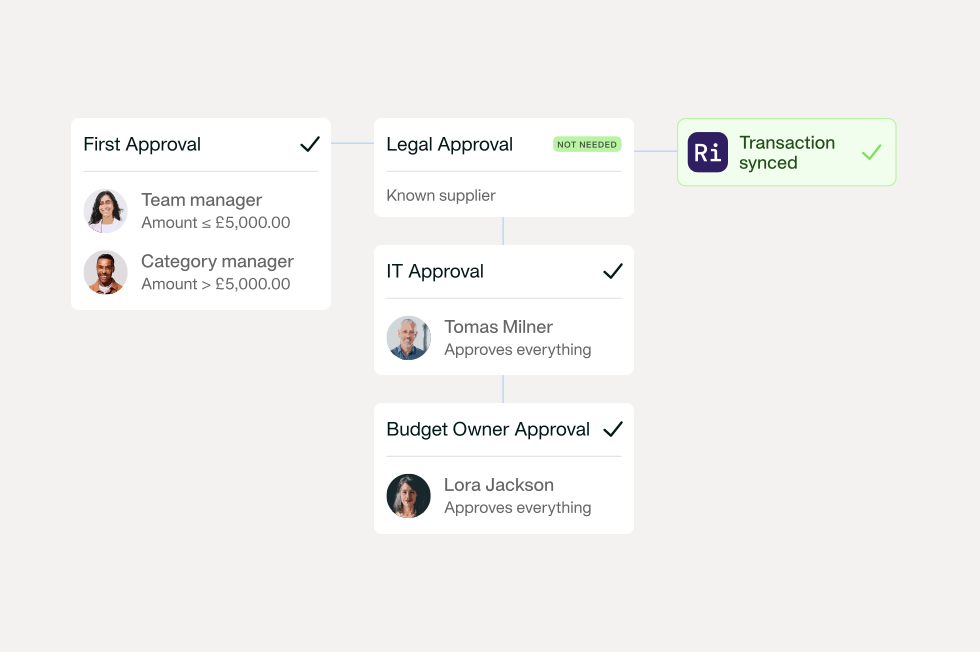
AI in accounts payable: what it automates and what humans verify
28 Sept 202613 min

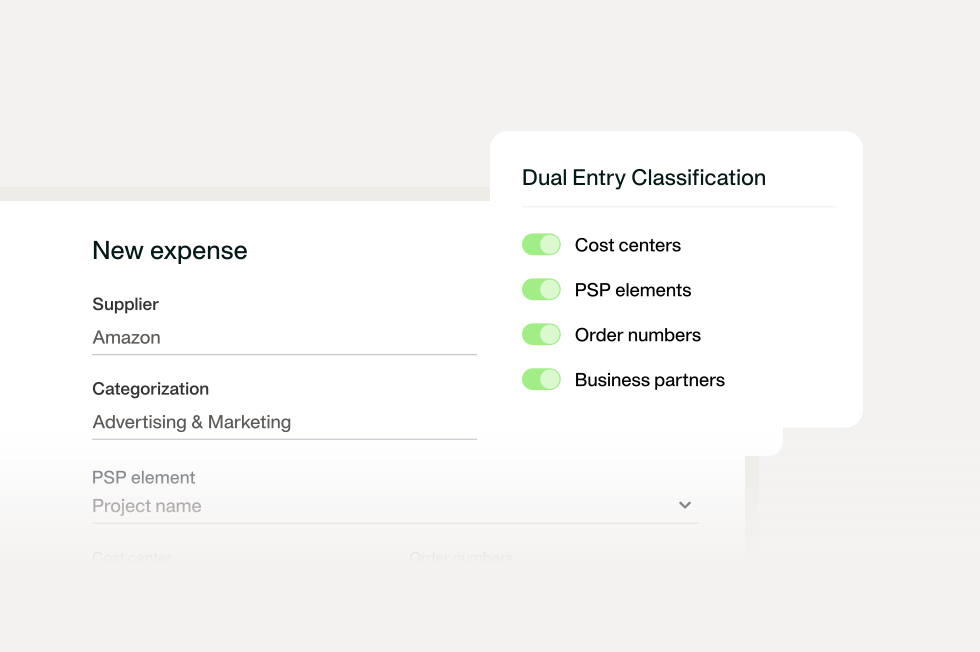
For a DualEntry integration to add true value to your month-end close, it needs to be fed clean, coded data. So, here’s why you should connect your spend platform to DualEntry, and what to demand from a spend platform before connecting it.

By submitting this form, you agree to receive emails about our products and services per our Privacy Policy.
An AI-native ledger will only close faster if the data reaching it is already coded, approved, and complete. It also just files the data but doesn't ask why the spend happened in the first place. DualEntry posts transactions in real time, but it can only post them as they arrive - coded or not, approved or not. A card transaction with no cost centre doesn't get fixed by the ledger. It gets inherited by it.
The connection between DualEntry and your spend platform has three jobs: hand over coded data in real time, cover cards, AP and employee spend through one route, and store the approval chain. Get those three right and the ledger does what it promises. Get them wrong and you keep the problems you changed ERP to escape.
Work this out while you are choosing the ledger, not after go-live. How spend reaches DualEntry decides what the close looks like six weeks later.
Payhawk's CFO AI Readiness Report puts it directly: in finance, scaling AI is less an integration problem than an orchestration problem. Integration connects systems and data. Orchestration governs how work actually moves - approvals, exceptions, logs, ownership. And orchestration is the weaker half. Across 1,520 finance and business leaders, 78% reported strong skills and tools, but only 55% had minimum governance rules in place. Which is how you end up with two systems that fully connect and a controller still chasing missing receipts and fixing miscoded transactions.
This difference matters because DualEntry posts continuously. If the platform feeding it works in scheduled batches, or sends partial records that get completed later, the ledger's real-time posting is spent on data that was never current.
None of that is visible on day one. It surfaces six weeks after go-live, when a controller tracks a transaction that looked fine on the surface and finds no project code underneath. So make the demo do the work: don't stop at watching the two systems exchange data. Ask to see a transaction carry its coding, its approvals and its evidence all the way into the ledger — in a sandbox, on your own chart of accounts.
A single source of truth is easy to describe and hard to build. You could mandate that everyone enters spend directly into the ledger, and on paper you'd have one set of numbers. In practice you'd have a gated system, a queue of untrained users, and a controller correcting them.
What works is the opposite: make the entry point easy enough that spend arrives without a detour, and push the ledger's masterdata out to meet it. When cost centres, entities and supplier records live in the spend platform, the person spending sees the current list at the moment they spend. The coding is right on the way in, rather than fixed on the way out.
Many finance teams are dealing with more disconnected systems than you might realise. Payhawk’s CFO Agenda research found that 98% of finance leaders believe tech helps them make better decisions, while 93% named centralised data analytics for financial planning and forecasting as a significant challenge. For finance leaders running multiple spend management tools, lack of visibility and transparency is the top challenge (85%), ahead of data quality and consistency (73%).
But by implementing a truly connected spend layer, this gap closes. When cards, AP and spend all post through the same route, into the same ledger, and are coded the same way, finance no longer has to reconcile the numbers; they can turn their attention to reviewing them instead.
DualEntry posts transactions as they happen. But this will only speed up the close if the data arriving is clean. That’s because, if it’s not clean, the ledger won’t remove exceptions; it just shows them to you quicker.
So the question isn't how quickly the close surfaces errors. It's how few reach the close at all. The strongest spend platforms stop the problem happening: policy applied at the point of spend, required fields that block submission, coding pulled from the ledger's current masterdata so the right cost centre is on the transaction before anyone reviews it. What can't be prevented gets flagged the moment it happens - a missing receipt chased on the day, not on day two of close review, when it's manual adjustments and a phone call.
The real-time, always-posting connection means every one of your transactions arrives pre-coded and approved.
Every ledger entry should be traceable. That means you should be able to trace it back to who asked for it, approved it, what policy applied, and what evidence backs it up. And all without anyone having to piece it together manually later.
If an auditor asks for the full story behind a specific transaction, you need a spend platform that carries the entire chain, from request to approval, payment, and coding. If you have scattered documentation, i.e. a receipt in an inbox or an approval somewhere in a Slack thread, and you can’t pull a full history of a transaction together inside a few minutes, your trail only exists on paper, and an auditor will find that gap quickly.
An AI-native stack raises a question a spreadsheet never did: if the system coded it, who can explain why? Payhawk keeps a transaction-level audit trail inside the platform for everything synced to DualEntry - what was coded, how, and why, including what the DualEntry AI agent changed after it arrived. The reasoning behind an automated posting is retrievable, not assumed. The request, approval and policy steps behind it stay in Payhawk too, so the full chain is in one place when an auditor asks.
Both sides of this connection are automated. DualEntry applies AI to the ledger. Payhawk applies it to everything that reaches the ledger - routing purchases to the right approvers, coding transactions against DualEntry's masterdata as spend happens, and capturing the evidence behind each one. Payhawk's AI agents cover expenses, procurement, travel and payments.
So the split is less about who does what, and more about where the automation starts.
Payhawk owns everything before the entry exists:
DualEntry owns the ledger and everything after that:
Neither replaces the other, and that's on purpose. A spend platform wasn't designed to consolidate multiple entities into one set of statutory accounts, and DualEntry wasn't designed to route a purchase order for sign-off. That routing, and the coding and chasing around it, is Payhawk's side of the line - and increasingly it's AI agents doing it rather than your team.
Keep these six things in mind when analysing your spend management vendor shortlist. Then, you’re benchmarking all your options at the same level.
This is the baseline for any platform feeding an AI-native ledger. Just because some of the vendors on your shortlist state they’re connected, make sure they at least meet these six points.
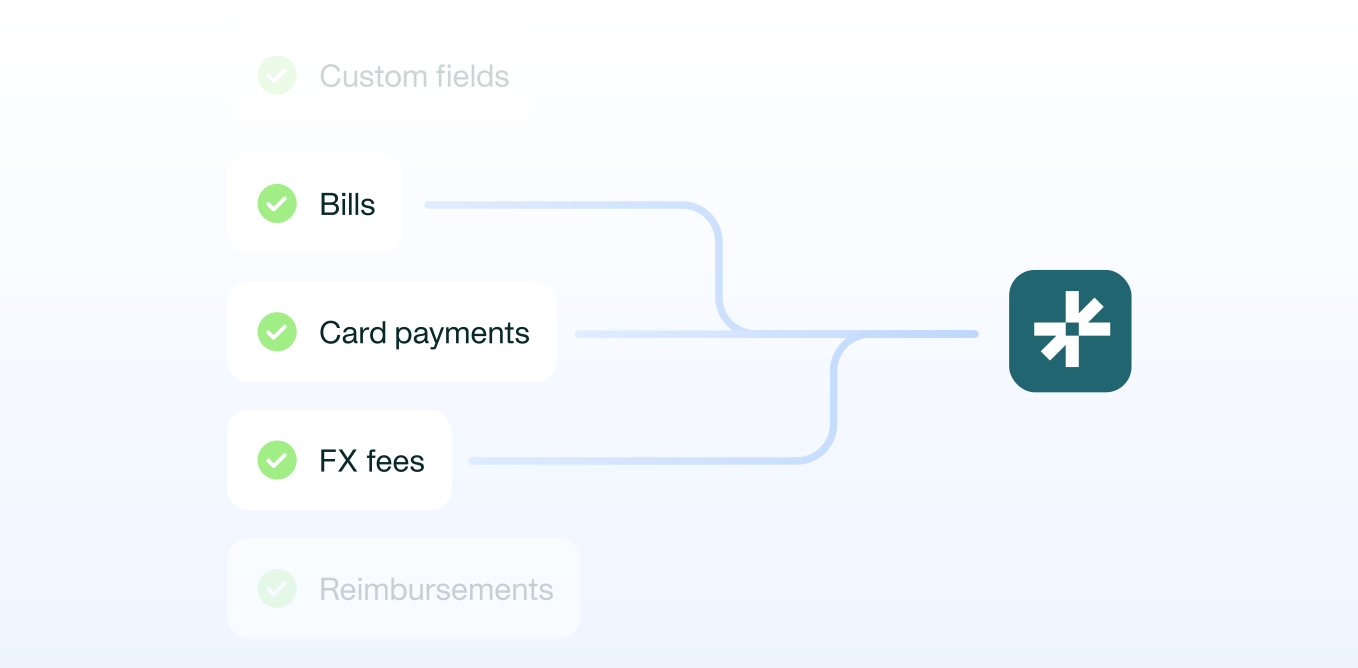
Automation is easy to demo on one entity. It gets harder with every border you cross. Different VAT regimes, different payment rails, different invoicing mandates, and a chart of accounts that isn't quite the same in Munich as it is in Madrid. Payhawk’s CFO Agenda research found 60% of finance leaders say getting complete, centralised spend control and visibility across multiple entities is extremely difficult.
Here's why it's the hard case for AI. Coding only works if it's reading the right masterdata - , and across European operations "the right masterdata" changes by market. A platform that syncs one set and applies it everywhere produces confident, consistent, wrong coding at scale.. Which is worse than no automation, because nobody checks it.
So the requirement isn't a multi-entity feature list. It's automation that adapts to each market it operates in, and four things underneath it:
Get the masterdata right per marketand the AI has something accurate to work from in each one. Get it wrong and you've automated the error.
Run the six questions at every vendor on your shortlist, and ask each of them to pull the full chain behind one transaction live on the call: who requested it, who approved it, which policy applied, and what evidence sits behind it. If that takes more than a few clicks in a demo, it will take an afternoon when an auditor asks.
Bring those six questions to us. Book a demo and we will walk DualEntry and Payhawk through them for a multi-entity, multi-currency setup.
Yes, Payhawk connects fully to DualEntry. This connection sees card payments, supplier invoices, and employee expenses posted through a single connection, carrying the coding and approval data the ledger needs.
Yes. Routing different spend types through different tools creates separate data formats and separate places for errors to crop up. Having one platform manage all three keeps the data and audit trail consistent all the way to the ledger.
With extensive experience in finance, marketing, and digital strategy, Raphael combines quantitative insights with compelling storytelling to drive regional marketing success and customer-focused innovation in financial SaaS solutions.