Why connect spend management to DualEntry
29 Sept 20269 min


"Traditional finance software automates what you define for it: workflow, policy, approval thresholds, exception paths. With AI, the constraint isn't capability, it's verifiability," explains Konstantin Dzhengozov, CFO and co-founder at Payhawk.

By submitting this form, you agree to receive emails about our products and services per our Privacy Policy.
In April, Uber’s chief technology officer, Praveen Neppalli Naga, revealed that the company had exhausted its entire 2026 AI budget in four months, driven largely by engineering’s adoption of AI coding tools. By June, Uber had capped spend at $1,500 (£1,100) per employee per month for each agentic tool, tracked on an internal dashboard.
Uber’s response to the overrun is more instructive than the overrun itself, because it did not slow adoption; it made consumption visible and set a limit on it. In essence, the smarter AI gets, the more tokens employees utilise, and the more expensive it may become to use at scale.
For CFOs, this challenges a core assumption that AI technology reduces costs in a linear, predictable way. In reality, several factors, including inference costs, usage spikes, and rework linked to poor data quality, can quickly erode expected gains.
Make finance your competitive advantage with AI automation in every workflow.

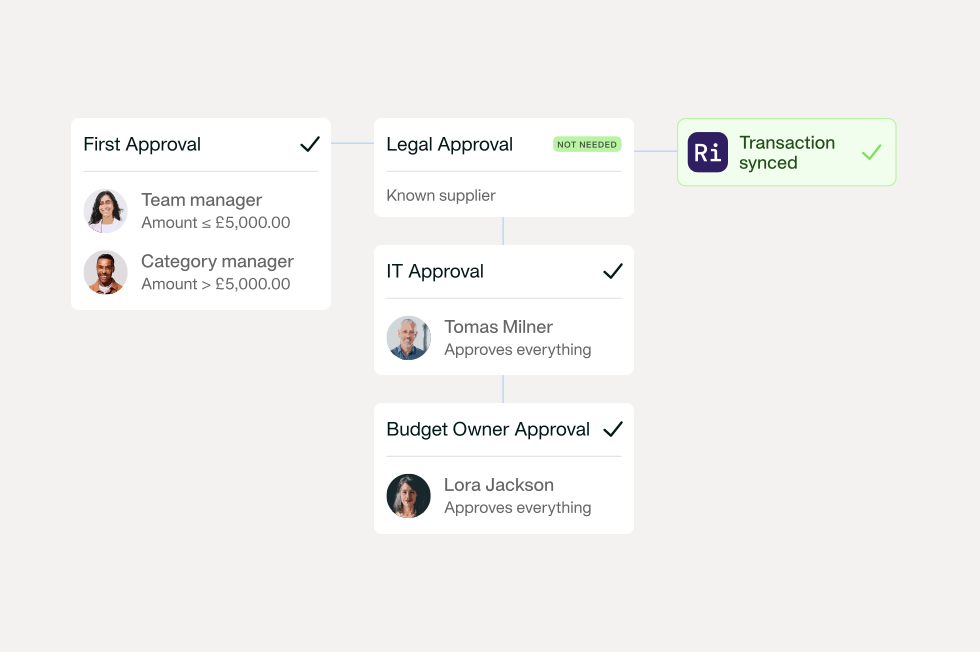
Traditional software automates what you can specify. You define the workflow, policy, approval threshold and exception path, and the system follows those instructions. AI is different. It automates what you can verify, and that distinction is often what separates a successful finance rollout from an expensive experiment.
In theory, finance should be well placed to benefit. Payments reconcile, books balance, and every ledger entry should be traceable. Few business functions produce outcomes that are easier to test. But that advantage only exists where the underlying rules are explicit, and the data is usable. In many organisations, neither is true.
Payhawk’s recent study of 1,520 finance and business decision-makers highlighted the gap. Among the 405 respondents who described their organisations as AI-mature, 78% reported strong skills and tools, while 69% had committed budgets. Yet only 61% had data ready for AI, and just 55% had established even minimum rules for its use. Only 26% were strong across all five dimensions.
The organisations that believe they are ahead invest in capability much faster than they build the conditions needed to control it. Their money and technical readiness are running more than 20% ahead of their rules.
.avif)
The real test is not whether a task is repetitive, but whether a correct answer exists independently of the model, and whether that answer can be checked quickly and cheaply.
Consider two routine finance processes. A three-way match has an external reference point: the purchase order and goods receipt exist whether or not the model runs. Its output can be verified in seconds, and any disagreement is useful because it identifies a specific exception.
A period-end accrual is different. There is no definitive answer available at the point of booking. The estimate can only be tested later, when the invoice arrives, after it has already affected the accounts and management reporting. Applied to the first task, AI delivers controlled automation. Applied to the second, it introduces judgement that may remain untested until the consequences are already embedded.
For accountancy and professional services firms, the distinction matters even more because the evidence trail is part of the deliverable. A conclusion without its supporting source is not almost complete. Someone must reconstruct the reasoning before they can review or sign it. Automation without provenance does not eliminate work. It shifts the work from producing the answer to rebuilding the basis for it, often at greater cost.
Both cases depend on the quality of the reference data underneath them. Automation can only be as reliable as the records it checks against. When the same supplier appears under four different names, the model does not remove the ambiguity. It escalates it. And once an exception reaches a person, resolving it can cost more than the routine task the system was meant to replace.

Within the next 12 months, CFOs must make five critical decisions with easily discernible impact measures.
Part of gaining control is working within specific frameworks to guide financial processes. The formula below explains how AI ROI could be measured.
AI ROI = (Annual value created - Annual AI investment) / Annual AI investment × 100
Two adjustments make that usable. Separate build cost from run cost: implementation is a one-off, consumption is a recurring liability that grows with success, so model payback against total cost of ownership rather than licence fees.
And put rework on the ledger. If output must be checked, corrected or reconciled by a person, that verification time belongs in the cost line. In finance, it is usually the largest one, and it is the number that tells you whether you automated a verifiable process or an unverifiable one.
For finance leaders, the real question is no longer where AI might create efficiency but which workflows can be automated today without breaking approvals, audit trails or accountability. That is how AI becomes a predictable, measurable asset for the business rather than an expensive experiment.
Kosio is the driving force behind Payhawk’s financial operations, strategic planning, and financial stability. With a background in management consulting and a trajectory through leading FP&A and investments, he co-founded Payhawk, earning the title of CFO of the Year in EY's awards. Outside the boardroom, he delights in tennis, snowboarding, mountain biking, and quality moments with friends, family and his two kids.