
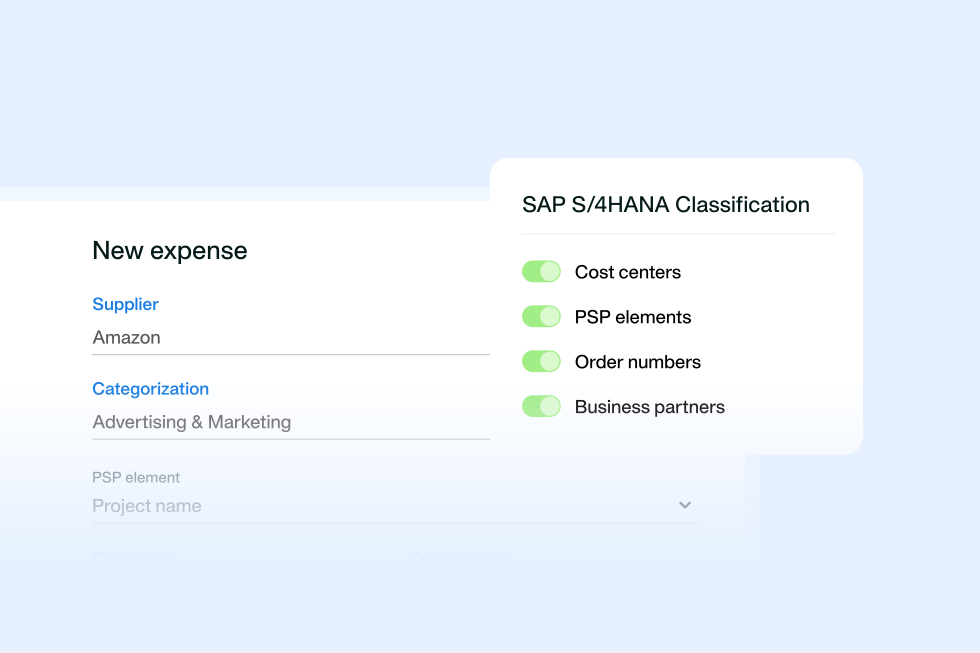
SAP S/4HANA procurement integration: what connects
13 Oct 202610 min


Most procurement software guides rank vendors by feature count. This one ranks them by finance control. For mid-market and multi-entity teams, finance-led platforms such as Payhawk bring requests, approvals, purchase orders, matching and supplier payments into one flow. Enterprises with dedicated sourcing teams usually choose Coupa, SAP Ariba, Ivalua or GEP, while smaller businesses often start with Precoro or Order.co. Compare them below, with a vendor checklist and scoring criteria to use today.

By submitting this form, you agree to receive emails about our products and services per our Privacy Policy.
The best procurement software looks different at every stage of growth because company size shapes what you buy, how much of it, and how streamlined those processes need to be. The best tool shouldn’t come down to how many sourcing features it has.
This guide sets out the finance-control criteria CFOs, controllers, and heads of finance should use to choose and compare the leading tools by company size, and explains where AI genuinely helps.
If you're evaluating procurement automation, spend management, or procure-to-pay tools, the market makes this harder than it needs to be. Most comparisons rank vendors by feature count or sourcing depth.
Finance teams need something different. Procurement shouldn’t treat finance as an afterthought. Finance is a key stakeholder, and needs a tool that stops spend going wrong in the first place, gives real-time visibility, reconciles cleanly with the ERP, and actually gets used by the people making purchases.
Procurement software manages how a business requests, approves, purchases, and pays for goods and services. It's sometimes used interchangeably with "purchasing software", but the two aren't quite the same. Purchasing is the transaction itself, while procurement covers the whole process, from request and approval through to supplier payment and reconciliation.
There are two sides to the procurement market: sourcing suites and operational spend control platforms.
This guide takes the financial-control view, because, for most mid-market teams, that’s where the risk and workload actually sit.
Procure-to-pay (P2P) software is the operational part of this: the flow from purchase request to approval, purchase order, invoice matching and payment. Sourcing and contract tools sit before it.
Build a procurement setup that fits your business
Before comparing vendors, it helps to know what "good" looks like. Here are six things to consider.
1. AI that executes inside controls, not around them. More on this below. AI allows for better and more natural intake, and should speed up requests, approvals, and matching within the rules you've set, not make autonomous purchasing decisions on your behalf. It enables simplicity but cannot be a black box.
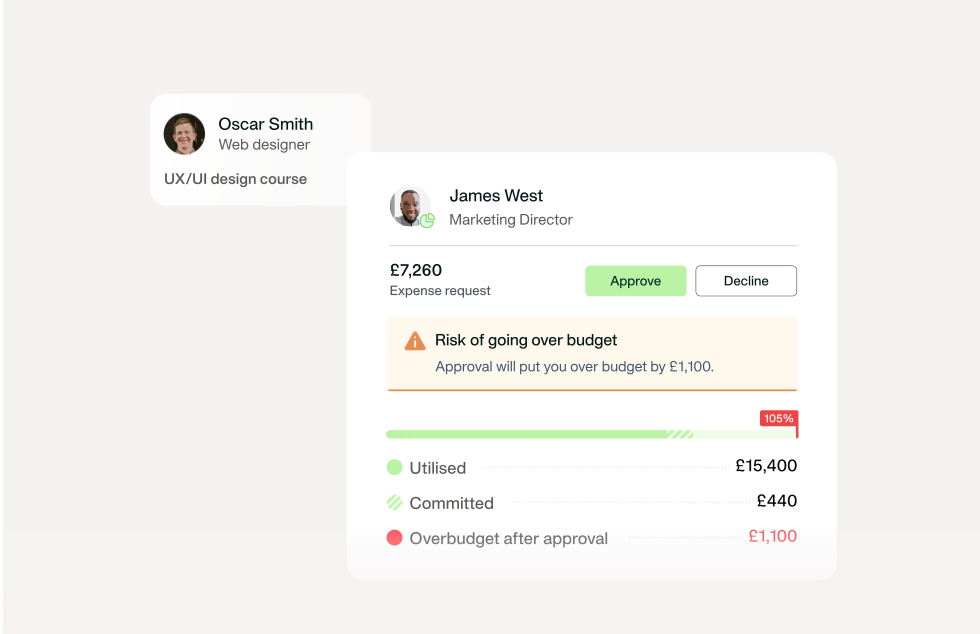
2. Control before spend, not just visibility after it. A dashboard that shows what's already been spent is reporting, not control. The tools worth paying for stop out-of-policy spend at the point of request, through approval workflows, budget checks, and purchase orders that are enforced, not advisory.
3. Orchestration, not integration alone. Bolting a procurement tool onto your existing card programme, expense system, and AP process with a handful of integrations creates gaps wherever those systems meet. Orchestration means one system coordinating requests, approvals, payments, and data across the whole spend lifecycle, which is also the direction the wider market is heading.
That may happen within one platform or across complementary systems, provided responsibilities are clear and data moves reliably between them. Gartner now tracks procurement orchestration platforms as an emerging category built specifically around coordinating workflows, data, and stakeholders across procurement technologies, rather than replacing every point tool a business already owns.
4. Multi-entity usability. If your business spans more than one legal entity, currency, or subsidiary, procurement needs to stay centrally manageable without losing flexibility for each entity. According to Payhawk’s CFO Agenda research, around 60% of finance leaders find complete, centralised spend control and visibility across multiple entities extremely challenging.
5. Book-ready data. Procurement should work in real time alongside your card spend, syncing cleanly with your ERP as it happens. A tool that can’t do that natively just moves the reconciliation problem from procurement to month-end.
6. Adoption, or people route around it. If the requester finds it easier to use their personal card or directly email the supplier, then even the best policy wouldn’t stop them. Make the right way the easiest one, because if the tool is slow or confusing, maverick spend will keep happening, and finance will continue to lose visibility where they most need it.
The table below assesses each potential vendor against the same criteria, making it easier to compare. The criteria are: control before spend, PO and AP coverage, real-time visibility, ERP fit, AI capacity, UX and adoption, implementation effort, pricing transparency, and best-fit company size.
This is a broad, factual comparison drawing on public vendor information alongside review data from sources such as G2's procurement category.
Use this as a starting checklist when you’re speaking to vendors:
| Criteria | Why it matters | Ask the vendor | Red flag |
|---|---|---|---|
| Control before spend | Prevents out-of-policy purchases rather than reporting them afterwards | “Can a request be blocked before approval if it breaks budget or policy?” | Policy is advisory only and relies on training rather than system enforcement |
| Real-time visibility | Finance needs current numbers for forecasting and board reporting | “How current is the spend data, and does it include committed but unpaid spend?” | The refresh frequency does not meet your reporting needs, or committed spend is excluded |
| Orchestration vs point integration | Clear workflow ownership and reliable data exchange reduce reconciliation gaps | “How are requests, approvals, payments, and accounting data coordinated across the platforms involved?” | The vendor cannot explain how workflows, permissions, and data remain consistent across systems |
| Multi-entity and ERP fit | Clean data exchange reduces manual journal entries and reconciliation work at month-end | “How does the platform map data to our chart of accounts across entities?” | The vendor cannot explain sync direction, error handling, corrections, or reconciliation |
| Breadth: purchase orders, cards, expenses, and accounts payable | Fragmented workflows can create gaps in control and visibility | “Which workflows are covered directly, and which require another platform?” | Process ownership is unclear, or the same transaction could be handled in multiple systems |
| AI capability | AI should reduce administration without introducing additional risk | “What can the AI act on, and which actions always require human approval?” | AI permissions, approval thresholds, exception handling, or audit trails are unclear |
| Adoption and user experience | Poor usability can encourage maverick spend and incomplete documentation | “Can you demonstrate how a new requester raises and tracks a purchase request?” | The vendor cannot demonstrate the requester journey or provide relevant adoption evidence |
| Implementation and time to value | Long or poorly scoped implementations delay the benefits of the software | “What is a realistic implementation plan for our entities, ERP, and approval structure?” | Scope, responsibilities, dependencies, and expected timelines are not clearly documented |
| Pricing transparency | Unclear costs make it difficult to forecast the total investment | “How is pricing calculated, and which implementation, integration, support, entity, or usage costs are additional?” | The proposal does not clearly identify all recurring and one-off costs |
Put procurement requests on autopilot

Company size changes what "best" means. A 40-person startup and a 3,000-person multi-entity group need different tools, not the same tool with more seats.
Small and growing businesses (under 200 employees) usually need something light: purchase requests, simple approvals, and a card programme, without the overhead of a full procurement suite. Precoro and Order.co are a good fit here, offering purchase order and approval workflows without enterprise complexity.
Mid-market and scaling businesses (roughly 200 to 5,000 employees) are the group most poorly served by the current market (they typically find out they need procurement after they needed it). They're often multi-entity or international, have lean finance teams doing the work of larger departments, and need enterprise-level control without enterprise-level implementation time. This is where the finance-control criteria above matter most.
Enterprise businesses typically need deep sourcing, supplier risk management, and complex contract negotiation, which is where suites like Coupa, SAP Ariba, Ivalua, and GEP are built to operate.
These platforms focus primarily on operational finance and spend workflows, including cards, expenses, purchase orders, invoices, approvals, or payments. Their capabilities overlap more directly, although their product scope and intended company profile still differ.
| Vendor | Best for | Pros | Cons | Best-fit company size |
|---|---|---|---|---|
| Payhawk | Finance-led control across cards, purchase orders, expenses, and accounts payable in one platform | Control before spend, real-time ERP sync, multi-entity support, and approval workflows set once at group level and inherited by each entity. | Less sourcing and contract-management depth than enterprise suites | Mid-market and scaling businesses with 200–5,000 employees |
| Ramp | Cards and expenses, with procurement (POs, two- and three-way matching, renewals) as an add-on to Ramp Plus or Enterprise; AI intake is included for all customers | Fast card issuing and expense automation | Advanced procurement is a paid add-on to Ramp Plus. Multi-entity requires Ramp Plus, and spend limits can’t be set per entity | Small to mid-market; US-led, live in the UK since September 2026 |
| Spendesk | Card- and expense-led spend management | Straightforward rollout and accessible employee workflows | May offer less depth for complex multi-entity structures or extensive purchase-order workflows | Small and growing businesses |
| Tipalti | Accounts payable and global payments | Strong accounts-payable automation and broad payment capabilities | Procurement request and approval functionality may be lighter than dedicated procurement platforms | Mid-market to enterprise, particularly accounts-payable-heavy organisations |
| Rippling | Spend management connected to HR and employee data | Links spend controls to the employee lifecycle and IT provisioning | Procurement is secondary to its HR platform and may be less suitable for complex international structures | Small to mid-market, primarily US-focused |
| Precoro | Purchase-order-based procurement | Straightforward implementation and clear approval workflows | Less depth across cards, expenses, payments, and multi-entity ERP requirements | Small and growing businesses |
| Order.co | Purchasing and vendor consolidation | Helps consolidate purchases across multiple suppliers | May provide less depth in finance controls and real-time budget visibility | Small and growing businesses |
Not every platform is a like-for-like alternative.
Coupa, SAP Ariba, Ivalua, and GEP are broad enterprise procurement platforms. They may remain the customer’s strategic sourcing, supplier-management, or group procurement system while a finance-led platform supports a separately defined operational spend workflow.
The appropriate setup depends on the customer’s architecture. Each request, approval, invoice, payment, and accounting entry should have one clearly defined owner.
| Vendor | Best for | Potential complementary role | Key design considerations |
|---|---|---|---|
| Coupa | Enterprise sourcing and supplier risk management | A finance-led platform may support a separately scoped card, expense, or operational spend workflow for selected entities or users | Avoid duplicated requests, approvals, invoices, and ERP postings |
| SAP Ariba | Enterprise sourcing, buying, invoicing, and supplier collaboration within SAP-centred environments | A defined operational finance workflow where the customer needs additional card or spend-management capabilities | Clarify ownership across SAP Ariba, the finance platform, and SAP ERP |
| Ivalua | Configurable enterprise sourcing and procurement | A focused finance workflow where appropriate | Define integration, master-data, and workflow ownership |
| GEP | Enterprise procurement and supply chain | A separately scoped operational spend process | Confirm that the platforms do not manage the same transaction twice |
| Zip | Enterprise intake and approval orchestration across departments | A finance-led platform may own card, expense, and payment execution downstream of the approval routing | Confirm which system owns the PO, the receipt, and the ERP posting |
For a closer look at PO-specific tools and where they fit alongside broader spend platforms, see our guide to the best purchase order software.
Mid-market businesses sit in an awkward gap. They're often multi-entity or international, but they rarely have a dedicated procurement team the size of an enterprise one. This means procurement usually sits with finance by default, which, as a team, can be understaffed. And finance needs audit trails that hold up at scale, approval workflows that don't require a specialist to configure, and a tool a lean team can actually run day to day, not one that needs a full-time administrator.
Aventum Group, a mid-market insurance business operating across multiple entities in the UK, faced exactly this. Group CFO Alex Curme needed PO control and approval workflows that worked across entities without adding headcount to manage them. Read how Aventum transformed its multi-entity spend management with a single system rather than stitching several together.
Deloitte's 2025 Global Chief Procurement Officer Survey covers more than 250 chief procurement officers across 40 countries. Its findings point to the same shift. That procurement is increasingly a C-suite concern rather than a purely operational one, with technology, talent, and agentic AI now firmly on the boardroom agenda. For mid-market finance leaders, that's a signal that procurement decisions deserve the same scrutiny as any other finance system, not a bolt-on evaluated by ops alone.
It depends on your entities, ERP and approval structure. Finance-led platforms are typically live in weeks rather than months, because they connect to your existing ERP instead of replacing processes around it. Enterprise suites with sourcing and contract modules usually take longer.
Procurement specialists in larger teams often use dedicated sourcing tools alongside a separate purchasing or spend system. This is because sourcing and day-to-day purchasing are different jobs. The problem shows up in the day-to-day purchasing tool: when the purchasing tool is slow or confusing, people stop using it.
This is where maverick spend creeps in. A requester who can't get a PO approved quickly enough books the purchase on a personal card, or emails a supplier directly. The audit trail breaks, and finance loses visibility at the exact moment it's needed. And a stricter policy won’t fix it. What will is a system fast enough and simple enough that following the process beats going around it.
A "no PO, no payment" policy, backed by a tool people actually want to use, closes this gap quickly. NordSecurity reached 60% PO coverage within six months of adopting this approach, turning a policy that existed on paper into one that held in practice.
The most useful version of AI in procurement software removes admin around a purchase while a human stays accountable for the decision. McKinsey puts the potential efficiency gain at 25 to 40%, though Payhawk's own research found only 26% of finance teams have the full conditions in place to scale AI safely, which is exactly why it needs to run inside existing controls rather than outside them.
For a closer look at what that means in practice, including Payhawk's procurement AI agent, which cuts request-to-purchase time by 60%, see our guide to finance AI agents.
The best procurement software for your business isn't the one with the longest feature list. It's the one that stops spend going wrong before it happens, gives finance real-time visibility rather than a monthly surprise, and reconciles cleanly against your ERP across every entity. And it needs to get used by the people making requests every day.
For enterprise businesses with dedicated procurement teams, deep sourcing suites like Coupa, SAP Ariba, Ivalua, or GEP still make sense. For mid-market and scaling businesses, where procurement sits with finance and lean teams need enterprise-level control without enterprise-level complexity, a platform built around procure-to-pay orchestration, rather than a stack of integrated point tools, is worth putting at the top of the shortlist.
Ready to see what that looks like for your business? Book a demo with the Payhawk team.
With extensive experience in finance, marketing, and digital strategy, Raphael combines quantitative insights with compelling storytelling to drive regional marketing success and customer-focused innovation in financial SaaS solutions.

